


Page 97 - IJOCTA-15-3
P. 97
Application of Jumarie-Stancu collocation series method and multi-Step
                                      Table 1. Equilibrium points and their Eigenvalues

                         Equilibrium point and Eigenvalues
                         E 1 (0.805, 1.815, 1.319)          Λ 1,2 = −1.7564 ± 7.5090i, Λ 3 = 1.3802
                         E 2 (0.624, 0.935, 0.877)          Λ 1,2 = 0.5262 ± 2.3472i, Λ 3 = −2.8372

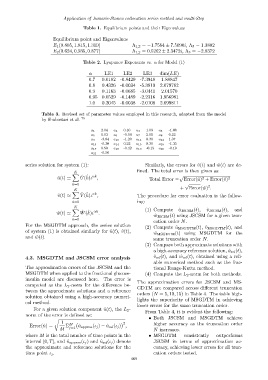
                                      Table 2. Lyapunov Exponents vs. α for Model (1)

                                         α     LE1      LE2      LE3    dim(LE)
                                         0.7  0.0182 -0.8429 -7.3948     1.88847
                                         0.8  0.4326 -0.0034 -5.3810 2.079762
                                         0.9  0.1163 -0.0685 -3.0441     2.01570
                                         0.95 0.0529 -0.1489 -2.2316 1.956981
                                         1.0  0.2045 -0.0038 -2.0108 2.099811

                    Table 3. Revised set of parameter values employed in this research, adapted from the model
                    by Shabestari et al.  75

                                         a 1  2.04  a 2  0.10  a 3  1.09  a 4  -1.08
                                         a 5  0.03  a 6  -0.06  a 7  2.01  a 8  0.22
                                         a 9  -3.84  a 10  -1.20  a 11  0.30  a 12  1.37
                                         a 13  -0.30  a 14  0.22  a 15  0.30  a 16  -1.35
                                         a 17  0.50  a 18  -0.42  a 19  -0.15  a 20  -0.19
                                         a 21  -0.56

            series solution for system (1):                       Similarly, the errors for ˆv(t) and ˆw(t) are de-
                                  K                           fined. The total error is then given as:
                                 X
                                          αk
                                     ˆ ˆ
                           ˆ u(t) ≃  U(k)ι ,                       Total Error = Error(ˆu) + Error(ˆv) 2
                                                                                 p
                                                                                           2
                                 k=0                                               √         2
                                                                                 +   Error( ˆw) .
                                  K
                                 X        αk
                                     ˆ ˆ
                           ˆ v(t) ≃  V (k)ι ,                 The procedure for error evaluation is the follow-
                                 k=0                          ing:
                                  K
                                     ˆ ˆ
                                 X         αk                    (1) Compute    ˆ u JSCSM (t),  ˆ v JSCSM (t),  and
                           ˆ w(t) ≃  W(k)ι .
                                                                      ˆ w JSCSM (t) using JSCSM for a given trun-
                                 k=0
                                                                     cation order N.
            For the MSGDTM approach, the series solution
                                                                 (2) Compute ˆu MSGDTM (t), ˆv MSGDTM (t), and
            of system (1) is obtained similarly for ˆu(t), ˆv(t),
                                                                      ˆ w MSGDTM (t) using MSGDTM for the
            and ˆw(t).
                                                                     same truncation order N.
                                                                 (3) Compare both approximate solutions with
                                                                     a high-accuracy reference solution, ˆu ref (t),
            4.3. MSGDTM and JSCSM error analysis                     ˆ v ref (t), and ˆw ref (t), obtained using a reli-
                                                                     able numerical method such as the frac-
            The approximation errors of the JSCSM and the            tional Runge-Kutta method.
            MSGDTM when applied to the fractional glucose-       (4) Compute the L 2 -norm for both methods.
            insulin model are discussed here. The error is
                                                              The approximation errors for JSCSM and MS-
            computed as the L 2 -norm for the difference be-
                                                              GDTM are compared across different truncation
            tween the approximate solutions and a reference   orders (N = 5, 10, 15) in Table 4. The table high-
            solution obtained using a high-accuracy numeri-   lights the superiority of MSGDTM in achieving
            cal method.
                                                              lower errors for the same truncation order.
                For a given solution component ˆu(t), the L 2 -
                                                                  From Table 4, it is evident the following:
            norm of the error is defined as:
                                                                   • Both JSCSM and MSGDTM achieve
                         r
                            1                           2           higher accuracy as the truncation order
              Error(ˆu) =     Σ M   ˆ u approx (ι j ) − ˆu ref (ι j ) ,
                                j=1
                            M                                        N increases.
            where M is the total number of time points in the      • MSGDTM        consistently  outperforms
            interval [0, T], and ˆu approx (ι j ) and ˆu ref (ι j ) denote  JSCSM in terms of approximation ac-
            the approximate and reference solutions for the          curacy, achieving lower errors for all trun-
            time point ι j .                                         cation orders tested.
                                                           469

