


Page 116 - IJOCTA-15-4
P. 116
Zhang et al. / IJOCTA, Vol.15, No.4, pp.649-669 (2025)


                                   Figure 5. Envelope spectrum of the simulated signal y(t)


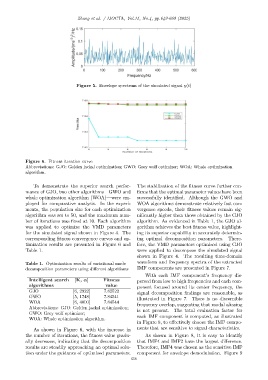
            Figure 6. Fitness iteration curve
            Abbreviations: GJO: Golden jackal optimization; GWO: Grey wolf optimizer; WOA: Whale optimization
            algorithm.


                To demonstrate the superior search perfor-    The stabilization of the fitness curve further con-
            mance of GJO, two other algorithms—GWO and        firms that the optimal parameter values have been
            whale optimization algorithm (WOA)—were em-       successfully identified. Although the GWO and
            ployed for comparative analysis. In the experi-   WOA algorithms demonstrate relatively fast con-
            ments, the population size for each optimization  vergence speeds, their fitness values remain sig-
            algorithm was set to 50, and the maximum num-     nificantly higher than those obtained by the GJO
            ber of iterations was fixed at 10. Each algorithm  algorithm. As evidenced in Table 1, the GJO al-
            was applied to optimize the VMD parameters        gorithm achieves the best fitness value, highlight-
            for the simulated signal shown in Figure 4. The   ing its superior capability in accurately determin-
            corresponding fitness convergence curves and op-  ing optimal decomposition parameters. There-
            timization results are presented in Figure 6 and  fore, the VMD parameters optimized using GJO
            Table 1.                                          were applied to decompose the simulated signal
                                                              shown in Figure 4. The resulting time-domain
            Table 1. Optimization results of variational mode  waveform and frequency spectra of the extracted
            decomposition parameters using different algorithms  IMF components are presented in Figure 7.
                                                                  With each IMF component’s frequency dis-
              Intelligent search  [K, α]       Fitness        persed from low to high frequencies and each com-
              algorithms                        value
                                                              ponent focused around its center frequency, the
              GJO                 [6, 2922]    7.82522        signal decomposition findings are reasonable, as
              GWO                 [5, 1748]    7.84541        illustrated in Figure 7. There is no discernible
              WOA                 [6, 4000]    7.84544
                                                              frequency overlap, suggesting that modal aliasing
              Abbreviations: GJO: Golden jackal optimization;  is not present. The total evaluation factor for
              GWO: Grey wolf optimizer;                       each IMF component is computed, as illustrated
              WOA: Whale optimization algorithm.
                                                              in Figure 8, to effectively choose the IMF compo-
                As shown in Figure 6, with the increase in    nents that are sensitive to signal characteristics.
            the number of iterations, the fitness value gradu-    As shown in Figure 8, it is easy to identify
            ally decreases, indicating that the decomposition  that IMF4 and IMF2 have the largest difference.
            results are steadily approaching an optimal solu-  Therefore, IMF4 was chosen as the sensitive IMF
            tion under the guidance of optimized parameters.  component for envelope demodulation. Figure 9
                                                           658

