


Page 214 - IJOCTA-15-4
P. 214
H. Kravitz et al. / IJOCTA, Vol.15, No.4, pp.750-778 (2025)
            the sum of the 2-norms of 5 major metropolitan    the optimization. Sometimes called the Rosen-
            areas: v 2 , v 3 , v 4 , v 7 , v 8 to find global estimates. To  brock banana function or the Rosenbrock val-
            avoid overfitting to unreliable fluctuations during  ley function, the typical Rosenbrock function is
            times of low case counts, we omit the first and last  constructed as an artificial problem that is dif-
            10 days of each epidemic curve from the objective  ficult to optimize due to its long, curving val-
            function. We use a combination of Matlab’s sim-   ley and sharp peaks on either side. 89,90  The clas-
            ulated annealing (SA) algorithm, 85  a derivative-  sic Rosenbrock function of the form f(x 1 , x 2 ) =
                                                                 2
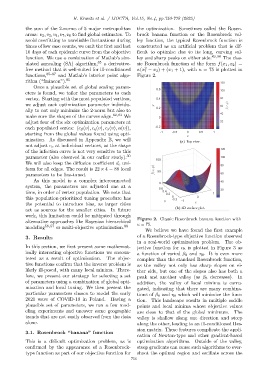
            free method that is well-suited for ill-conditioned  κ(x − x 2 ) + (x 1 + 1), with κ = 75 is plotted in
                                                                 1
            functions, 85–87  and Matlab’s interior point algo-  Figure 2.
            rithm (“fmincon”). 85
                Once a plausible set of global scaling param-
            eters is found, we tailor the parameters to each
            vertex. Starting with the most populated vertices,
            we adjust each optimization parameter individu-
            ally to not only minimize the 2-norm but also to
            make sure the shapes of the curves align. 62,63  We
            adjust four of the six optimization parameters at
            each populated vertex: (c β (v), c η (v), c λ (v), α(v)),
            starting from the global values found using opti-
            mization. As discussed in Appendix B, we will
            not adjust c v at individual vertices, as the shape
            of the infection curve is not very sensitive to this
            parameter (also observed in our earlier study). 30
            We will also keep the diffusion coefficient d e uni-
            form for all edges. The result is 22 × 4 = 88 local
            parameters to be fine-tuned.
                As this model is a complex interconnected
            system, the parameters are adjusted one at a
            time, in order of vertex population. We note that
            this population-prioritized tuning procedure has
            the potential to introduce bias, as larger cities
            act as sources for the smaller cities. In future
            work, this limitation could be mitigated through
                                                              Figure 2. Classic Rosenbrock banana function with
            alternative approaches like Bayesian hierarchical
            modeling 56,57  or multi-objective optimization. 88  κ = 75.
                                                                  We believe we have found the first example
            3. Results                                        of a Rosenbrock-type objective function observed
                                                              in a real-world optimization problem. The ob-
            In this section, we first present some mathemat-  jective function for v 8 is plotted in Figure 3 as
            ically interesting objective functions we encoun-  a function of varied β 8 and η 8 . It is even more
            tered as a result of optimization.  The objec-    complex than the standard Rosenbrock function,
            tive functions confirm that the inverse problem is  as the valley not only has sharp slopes on ei-
            likely ill-posed, with many local minima. There-  ther side, but one of the slopes also has both a
            fore, we present our strategy for selecting a set  peak and another valley (as β 8 decreases). In
            of parameters using a combination of global opti-  addition, the valley of local minima is corru-
            mization and local tuning. We then present the    gated, indicating that there are many combina-
            particular parameters chosen to model the early   tions of β 8 and η 8 which will minimize the func-
            2021 wave of COVID-19 in Poland. Having a         tion. This landscape results in multiple saddle
            plausible set of parameters, we run a few mod-    points and local minima whose objective values
            eling experiments and uncover some geographic     are close to that of the global minimum. The
            trends that are not easily observed from the data  valley is shallow along one direction and steep
            alone.                                            along the other, leading to an ill-conditioned Hes-
                                                              sian matrix. These features complicate the appli-
            3.1. Rosenbrock “banana” function
                                                              cation of Newton-type and other gradient-based
            This is a difficult optimization problem, as is   optimization algorithms. Outside of the valley,
            confirmed by the appearance of a Rosenbrock-      steep gradients can cause such algorithms to over-
            type function as part of our objective function for  shoot the optimal region and oscillate across the
                                                           756

