


Page 215 - IJOCTA-15-4
P. 215
Data-driven optimization and parameter estimation for an epidemic model
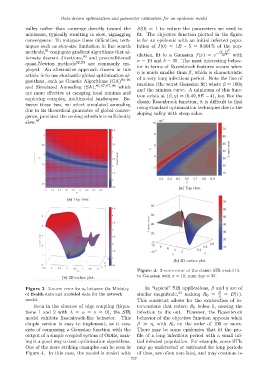
            valley rather than converge directly toward the   S(0) = 1 to reduce the parameters we need to
            minimum, typically resulting in slow, zigzagging  fit. The objective function plotted in the figure
            convergence. To mitigate these difficulties, tech-  is for an epidemic with an initial infected popu-
            niques such as step-size limitation in line search  lation of I(0) = 1E − 5 = 0.001% of the pop-
            methods, 91  conjugate gradient algorithms that al-  ulation, fit to a Gaussian f(x) = e −  (x−b) 2  with
                                                                                                    2σ 2
            ternate descent directions, 90  and preconditioned  σ = 10 and b = 35. The most interesting behav-
            quasi-Newton methods   92,93  are commonly em-
                                                              ior in terms of Rosenbrock features occurs when
            ployed. An alternative approach chosen in this
                                                              η is much smaller than β, which is characteristic
            article is to use stochastic global optimization al-  of a very long infectious period. Note the line of
            gorithms, such as Genetic Algorithms (GA)  94–96  maxima (the worst Gaussian fit) where β = 100η
            and Simulated Annealing (SA),   86,87,97,98  which
                                                              and the minima curve. A minimum of this func-
            are more effective at escaping local minima and
                                                              tion exists at (β, η) ≈ (0.49, 8E − 4), but like the
            exploring complex, multimodal landscapes. Be-     classic Rosenbrock function, it is difficult to find
            tween these two, we select simulated annealing
                                                              using standard optimization techniques due to the
            due to its theoretical guarantee of global conver-
                                                              sloping valley with steep sides.
            gence, provided the cooling schedule is sufficiently
            slow. 97


                                                              Figure 4. 2-norm error of the classic SIR model fit
                                                              to Gaussian with σ = 10, max day = 35.


            Figure 3. 2-norm error for v 8 between the Ministry   In “typical” SIR applications, β and η are of
            of Health data and modeled data for the network   similar magnitude, 24  making R 0 =  β η  = O(1).
            model.                                            This construct allows for the exploration of in-
                Even in the absence of edge coupling (Equa-   terventions that reduce R 0 below 1, causing the
            tions 1 and 2 with λ = α = v = 0), the SIR        infection to die out. However, the Rosenbrock
            model exhibits Rosenbrock-like behavior. This     behavior of the objective function appears when
            simple version is easy to implement, as it con-   β ≫ η, with R 0 on the order of 100 or more.
            sists of comparing a Gaussian function with the   There may be some epidemics that fit the pro-
            output of a simple coupled system of ODEs, mak-   file of a long infectious period with a small ini-
            ing it a good way to test optimization algorithms.  tial infected population. For example, some STIs
            One of the more striking examples can be seen in  may go undetected or untreated for long periods
            Figure 4. In this case, the model is scaled with  of time, are often non-fatal, and may continue to
                                                           757

