Page 54 - IJOCTA-15-4
P. 54

MN. Khan et.al. / IJOCTA, Vol.15, No.4, pp.594-609 (2025)
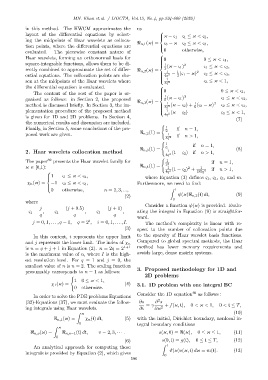
            in this method. The HWCM approximates the         us
            layout of the differential equations by select-             
                                                                        κ − ς 1  ς 1 ≤ κ < ς 2 ,
            ing the midpoints of Haar wavelets as colloca-              
                                                              ℜ n,1 (κ) =  ς 3 − κ  ς 2 ≤ κ < ς 3 ,
            tion points, where the differential equations are           
                                                                         0       otherwise,
            evaluated.   The piecewise constant nature of
                                                                        
            Haar wavelets, forming an orthonormal basis for              0                 0 ≤ κ < ς 1 ,
                                                                        
            square-integrable functions, allows them to be di-            (κ − ς 1 ) 2     ς 1 ≤ κ < ς 2 ,
                                                                         1
                                                                        
            rectly combined to approximate the set of differ-  ℜ n,2 (κ) =  2
                                                                           1 2 − (ς 1 − κ) 2  ς 2 ≤ κ < ς 3 ,
                                                                                1
            ential equations. The collocation points are cho-            4q    2
                                                                        
                                                                        
                                                                        
            sen at the midpoints of the Haar wavelets where              1                 ς 3 ≤ κ < 1,
                                                                          4q  2
            the differential equation is evaluated.                     
                                                                         0                        0 ≤ κ < ς 1 ,
                The content of the rest of the paper is or-             
                                                                        
                                                                         1  (κ − ς 1 ) 3          ς 1 ≤ κ < ς 2 ,
                                                                        
            ganized as follows: in Section 2, the proposed                6
                                                              ℜ n,3 (κ) =  1           1        3
            method is discussed briefly. In Section 3, the im-              2 (κ − ς 2 ) + (ς 3 − κ)  ς 2 ≤ κ < ς 3 ,
                                                                         4q           6
                                                                        
                                                                        
            plementation procedure of the proposed method                1 2 (κ − ς 2 )           ς 3 ≤ κ < 1,
                                                                        
                                                                          4q
            is given for 1D and 2D problems. In Section 4,
                                                                                                          (7)
            the numerical results and discussion are included.
                                                                         (
            Finally, in Section 5, some conclusions of the pro-            1    if  n = 1,
                                                               ℜ n,2 (1) =  2
            posed work are given.                                          1    if  n > 1,
                                                                           4q 2
                                                                         (
                                                                           1           if  n = 1,
                                                               ℜ n,3 (1) =  6                             (8)
            2. Haar wavelets collocation method                            1 2 (1 − ς 2 )  if  n > 1,
                                                                           4q
                                                                           1
            The paper 39  presents the Haar wavelet family for           ( 24                  if  n = 1,
            κ ∈ [0,1):                                         ℜ n,4 (1) =  1        2    1    if  n > 1,
                                                                           4q 2 (1 − ς 2 ) +  192q  4
                      
                      1     ς 1 ≤ κ < ς 2 ,
                                                                 where Equation (3) defines ς 1 , ς 2 , ς 3 , and m.
             χ n (κ) =  −1   ς 2 ≤ κ < ς 3 ,                  Furthermore, we need to find:
                      
                        0    otherwise,        n = 2, 3, ...,
                                                                            Z  1
                                                        (2)                     ψ(κ)ℜ n,2 (t) dt,         (9)
                                                                              0
            where
                                                                  Consider a function ψ(κ) is provided. Evalu-
                   j          (j + 0.5)          (j + 1)
              ς 1 = ,    ς 2 =         ,    ς 3 =       ,     ating the integral in Equation (9) is straightfor-
                   q              q                 q
                                                              ward.
                                        i
                j = 0, 1, . . . , q − 1,  q = 2 ,  i = 0, 1, . . . , I.  The method’s complexity is linear with re-
                                                        (3)   spect to the number of collocation points due
                In this context, i represents the upper limit  to the sparsity of Haar wavelet basis functions.
                                                              Compared to global spectral methods, the Haar
            and j represents the lower limit. The index of χ n
            is n = q + j + 1 in Equation (2). n = 2q = 2 I+1  method has lower memory requirements and
            is the maximum value of n, where I is the high-   avoids large, dense matrix systems.
            est resolution level. For q = 1 and j = 0, the
            smallest value of n is n = 2. The scaling function
                                                              3. Proposed methodology for 1D and
            presumably corresponds to n = 1 as follows:
                                                                 2D problems
                                (
                                  1  0 ≤ κ < 1,
                        χ 1 (κ) =                       (4)   3.1. 1D problem with one integral BC
                                  0  otherwise.
                                                              Consider the 1D equation 40  as follows :
                In order to solve the PDE problems Equations
                                                                       2
            (32)-Equations (37), we must evaluate the follow-  ∂s  = γ  ∂ s  + f(κ, t),  0 < κ < 1,  0 < t ≤ T,
            ing integrals using Haar wavelets.                 ∂t     ∂κ 2
                                                                                                         (10)
                                   Z
                                     κ
                         ℜ n,1 (κ) =   χ n (t) dt,      (5)   with the initial, Dirichlet boundary, nonlocal in-
                                    0                         tegral boundary conditions
                           κ
                         Z
               ℜ n,v (κ) =   ℜ n,v−1 (t) dt,  v = 2, 3, · · · .         s(κ, 0) = ℜ(κ),  0 ≤ κ ≤ 1,      (11)
                          0
                                                        (6)              s(0, t) = g(t),  0 ≤ t ≤ T,     (12)
                                                                         Z  1
                An analytical approach for computing these
                                                                            ϑ(κ)s(κ, t) dκ = m(t).       (13)
            integrals is provided by Equation (2), which gives
                                                                          0
                                                           596
   49   50   51   52   53   54   55   56   57   58   59