


Page 59 - IJOCTA-15-4
P. 59
Solving parabolic differential equations via Haar wavelets: A focus on integral boundary conditions
            From Equations (17), (44), and (43), we have:     coarse selection of collocation points, the method

                 s(L, t) − s(L, t 0 )                         achieves satisfactory accuracy, which improves
                                 = γ (H ⊗ 1)σ+                as M increases and dt decreases. Additionally,
                       ∆t
                 (H ⊗ y)δ + (1 ⊗ H)ζ + (L ⊗ H)ω+       (53)   Figures 1-2 depict the method’s performance in
                                                              terms of L ∞ . It is evident from these figures that

                 ((ℜ 2 ⊗ H) + (H ⊗ ℜ 2 ))µ + f(L, t).         the method’s accuracy remains relatively stable
                                                              regardless of the increase in collocation points M
                                                              or changes in ϑ.
                                                          2
            According to Equation (53), a system of 4M
                                   2
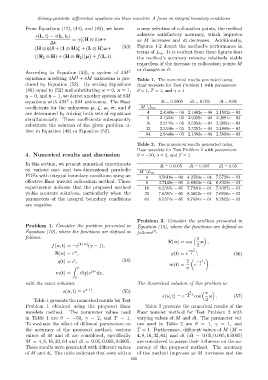
            equations involving 4M + 8M unknowns is pro-      Table 1. The numerical results generated using
            duced by Equation (52). By setting Equations      Haar wavelets for Test Problem 1 with parameters
            (48) equal to (52) and substituting κ = 0, κ = 1,  ϑ = 1, T = 1, and γ = 1
            y = 0, and y = 1, we derive another system of 8M
                               2
            equations with 4M + 8M unknowns. The Haar                    dt = 0.0005  dt = 0.005   dt = 0.05
            coefficients for the unknowns µ, ζ, ω, σ, and δ     M \L ∞
            are determined by solving both sets of equations      4     2.4349e − 04 2.1402e − 04 2.1902e − 03
            simultaneously. These coefficients subsequently       8     2.1342e − 05 2.6395e − 04 2.3891e − 03
                                                                  16    2.2141e − 05 2.5393e − 04 2.2890e − 03
            substitute the solution of the given problem ei-
                                                                  32    2.5340e − 05 2.3393e − 04 2.1889e − 03
            ther in Equation (48) or Equation (52).
                                                                  64    2.6340e − 05 2.1393e − 04 2.5889e − 03
                                                              Table 2. The numerical results generated using
                                                              Haar wavelets for Test Problem 2 with parameters
            4. Numerical results and discussion               ϑ = −50, γ = 2, and T = 1

            In this section, we present numerical experiments
                                                                        dt = 0.0005  dt = 0.005   dt = 0.05
            on various one- and two-dimensional parabolic
                                                               M \L ∞
            PDEs with integral boundary conditions using an       4     3.5616e − 04 4.2593e − 04 7.5728e − 03
            effective Haar wavelet collocation method. These      8     3.7148e − 05 6.8963e − 04 6.8353e − 03
            experiments indicate that the proposed method        16     6.2383e − 05 7.7280e − 04 7.8397e − 03
            yields accurate solutions, particularly when the     32     7.6387e − 05 8.5852e − 04 7.6956e − 03
            parameters of the integral boundary conditions       64     8.5374e − 05 8.7694e − 04 8.7802e − 03
            are negative.


                                                              Problem 2. Consider the problem presented in
            Problem 1. Consider the problem presented in      Equation (10), where the functions are defined as
                                                                    40
            Equation (10), where the functions are defined as  follows :
            follows:                                                                     π
                                                                            ℜ(κ) = cos    κ ,
                        f(κ, t) = −e (t+κ) (γ − 1),                                     2
                                                                                     −π 2 t
                                  κ
                         ℜ(κ) = e ,                                          g(t) = e  4 ,               (56)
                                  t
                           g(t) = e ,                  (54)                         2    −π 2 t
                                                                            m(t) =     e  4   .
                                   1                                                π
                                 Z
                          m(t) =     ϑ(x)e x+t dx,
                                  0
            with the exact solution:                          The theoretical solution of this problem is:
                             s(κ, t) = e κ+t .         (55)                        −π 2     π
                                                                         s(κ, t) = e  4  t  cos  κ .     (57)
                Table 1 presents the numerical results for Test                             2
            Problem 1 obtained using the proposed Haar            Table 2 presents the numerical results of the
            wavelets method.    The parameter values used     Haar wavelet method for Test Problem 2 with
            in Table 1 are ϑ = −50, γ = 2, and T = 1.         varying values of M and dt. The parameter val-
            To evaluate the effect of different parameters on  ues used in Table 2 are ϑ = 1, γ = 1, and
            the accuracy of the proposed method, various      T = 1. Furthermore, different values of M (M =
            values of M and dt are considered, specifically   4, 8, 16, 32, 64) and dt (dt = 0.05, 0.005, 0.0005)
            M = 4, 8, 16, 32, 64 and dt = 0.05, 0.005, 0.0005.  are considered to assess their influence on the ac-
            These results were generated with different values  curacy of the proposed method. The accuracy
            of M and dt. The table indicates that even with a  of the method improves as M increases and the
                                                           601

