


Page 61 - IJOCTA-15-4
P. 61
Solving parabolic differential equations via Haar wavelets: A focus on integral boundary conditions
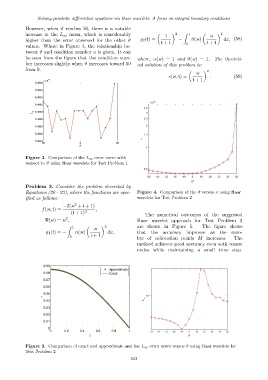
            However, when ϑ reaches 20, there is a notable
            increase in the L ∞ norm, which is considerably              1   2   Z  1      κ   2
            higher than the error observed for the other ϑ     g 2 (t) =        −     ϑ(κ)          dx, (58)
                                                                         t + 1      0        t + 1
            values. Where in Figure 4, the relationship be-
            tween ϑ and condition number κ is given. It can
            be seen from the figure that the condition num-   where, α(κ) = 1 and ϑ(κ) = 1. The theoreti-
            ber increases slightly when ϑ increases toward 50  cal solution of this problem is:
            from 0.                                                                        2
                                                                                        κ
                                                                            s(κ, t) =         .          (59)
                      −5                                                               t + 1
                    x 10
                 8.4083
                 8.4083
                 8.4083
                 8.4083
               L ∞    8.4083

                 8.4083
                 8.4083
                 8.4083
                 8.4083
                   −50              0                50
                                    ϑ
            Figure 2. Comparison of the L ∞ error norm with
            respect to ϑ using Haar wavelets for Test Problem 1


            Problem 3. Consider the problem described by
            Equations (20 - 23), where the functions are spec-  Figure 4. Comparison of the ϑ versus κ using Haar
            ified as follows:                                 wavelets for Test Problem 2
                                  2
                             −2(κ + t + 1)
                    f(κ, t) =              ,
                                 (t + 1) 3
                                                                  The numerical outcomes of the suggested
                              2
                     ℜ(κ) = κ ,                               Haar wavelet approach for Test Problem 3
                               Z  1           2             are shown in Figure 5.       The figure shows
                                           κ
                     g 1 (t) = −  α(κ)           dx,          that  the  accuracy   improves  as   the  num-
                                0        t + 1                ber of collocation points M increases.     The
                                                              method achieves good accuracy even with coarse
                                                              nodes while maintaining a small time step.


                    0.09
                                                  Approximate
                    0.08                          Exact
                    0.07
                    0.06
                    0.05
                    s
                    0.04
                    0.03
                    0.02
                    0.01
                      0
                       0      0.2    0.4    0.6    0.8    1
                                         x
            Figure 3. Comparison of exact and approximate and the L ∞ error norm versus ϑ using Haar wavelets for
            Test Problem 2
                                                           603

