


Page 64 - IJOCTA-15-4
P. 64
MN. Khan et.al. / IJOCTA, Vol.15, No.4, pp.594-609 (2025)

                     1.4
                     1.2
                      1
                     0.8
                     0.6
                     0.4
                     0.2
                      0
                      −80  −70  −60  −50  −40  −30  −20  −10  0  10
                                   α
                                   1
                     1.4
                     1.2
                      1
                     0.8
                     0.6
                     0.4
                     0.2
                      0
                      −80  −70  −60  −50  −40  −30  −20  −10  0  10
                                   α
                                   2
                     6000
                     5000
                     4000
                     3000
                     2000
                     1000
                      0
                      −80  −70  −60  −50  −40  −30  −20  −10  0  10
                                   α

                                                                                                    42
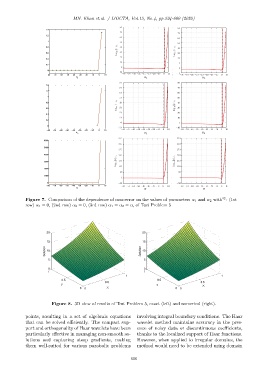
            Figure 7. Comparison of the dependence of max-error on the values of parameters α 1 and α 2 with : (1st
            row) α 1 = 0, (2nd row) α 2 = 0, (3rd row) α 1 = α 2 = α, of Test Problem 5


                      20                                        20
                      15                                        15
                     Solution  10                               Solution  10


                      5                                          5
                      0                                          0
                      1                                          1
                                                         1                                         1
                            0.5                                        0.5
                                                0.5                                       0.5
                            y                                          y                   x
                                    0  0        x                              0  0


                        Figure 8. 3D view of results of Test Problem 5, exact (left) and numerical (right).

            points, resulting in a set of algebraic equations  involving integral boundary conditions. The Haar
            that can be solved efficiently. The compact sup-  wavelet method maintains accuracy in the pres-
            port and orthogonality of Haar wavelets have been  ence of noisy data or discontinuous coefficients,
            particularly effective in managing non-smooth so-  thanks to the localized support of Haar functions.
            lutions and capturing steep gradients, making     However, when applied to irregular domains, the
            them well-suited for various parabolic problems   method would need to be extended using domain


                                                           606

