


Page 57 - IJOCTA-15-4
P. 57
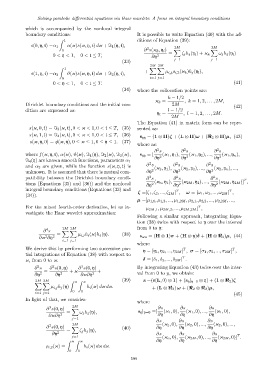
Solving parabolic differential equations via Haar wavelets: A focus on integral boundary conditions
            which is accompanied by the nonlocal integral
            boundary conditions:                              It is possible to write Equation (40) with the ad-
                           Z  1                               ditions of Equation (39):
               s(0, y, t) =α 1  α(κ)s(κ, y, t) dκ + ℑ 1 (y, t),               2M               2M
                                                                  2
                            0                                    ∂ s(κ k , y l )  X            X
                         0 < y < 1,  0 < t ≤ T,                     ∂y 2    =     ζ j h j (y l ) + κ k  ω j h j (y l )
                                                                              j=1              j=1
                                                       (33)
                                                                    2M 2M
                           Z  1                                    X X
                                                                 +        µ i,j ρ i,2 (κ k )h j (y l ),
               s(1, y, t) =α 2  ϑ(κ)s(κ, y, t) dκ + ℑ 2 (y, t),
                             0                                      i=1 j=1
                         0 < y < 1,  0 < t ≤ T.                                                          (41)
                                                       (34)   where the collocation points are:
                                                                            k − 1/2
                                                                      κ k =        , k = 1, 2, . . . , 2M,
            Dirichlet boundary conditions and the initial con-               2M                          (42)
            dition are expressed as:                                        l − 1/2
                                                                       y l =      , l = 1, 2, . . . , 2M.
                                                                             2M
                                                              The Equation (41) in matrix form can be repre-
              s(κ, 0, t) = ℑ 3 (κ, t), 0 < κ < 1, 0 < t ≤ T, (35)  sented as:
              s(κ, 1, t) = ℑ 4 (κ, t), 0 < κ < 1, 0 < t ≤ T, (36)  s yy = (1 ⊗ H)ζ + (L ⊗ H)ω + (ℜ 2 ⊗ H)µ, (43)
              s(κ, y, 0) = ϕ(κ, y), 0 ≤ κ ≤ 1, 0 ≤ y ≤ 1. (37)
                                                              where as:
                                                                                                 2
                                                                                   2
                                                                       2
                                                                      ∂ s        ∂ s            ∂ s
            where f(κ, y, t), α(κ), ϑ(κ), ℑ 1 (y), ℑ 2 (κ), ℑ 3 (κ),  s yy = [  (κ 1 , y 1 ),  (κ 1 , y 2 ), ...,  (κ 1 , y n ),
                                                                      ∂y 2       ∂y 2           ∂y 2
            ℑ 4 (y) are known smooth functions, parameters α 1     2           2              2
            and α 2 are given, while the function s(κ, y, t) is   ∂ s (κ 2 , y 1 ),  ∂ s (κ 2 , y 2 ), ...,  ∂ s  (κ 2 , y n ), ...,
            unknown. It is assumed that there is mutual com-      ∂y 2        ∂y 2           ∂y 2
                                                                                                2
                                                                               2
                                                                   2
            patibility between the Dirichlet boundary condi-      ∂ s         ∂ s              ∂ s           T
            tions (Equations (35) and (36)) and the nonlocal      ∂y 2  (κ n , y 1 ),  ∂y 2  (κ 2M , y 2 ), ...,  ∂y 2 (κ 2M , y 2M )] ,
            integral boundary conditions (Equations (33) and                   T                       T
                                                              ζ =[ζ 1 , ζ 2 , ..., ζ 2M ] ,  ω = [ω 1 , ω 2 , ..., ω 2M ] ,
            (34)).
                                                              µ =[µ 1,1 , µ 1,2 , ..., µ 1,2M , µ 2,1 , µ 2,2 , ..., µ 2,2M , ...,
            For the mixed fourth-order derivative, let us in-     µ 2M,1 , µ 2M,2 , ..., µ 2M,2M ] ,
                                                                                         T
            vestigate the Haar wavelet approximation:
                                                              Following a similar approach, integrating Equa-
                                                              tion (38) twice with respect to y over the interval
                             2M 2M
                      4
                    ∂ s      X X                              from 0 to y:
                          =         µ i,j h i (κ)h j (y).  (38)
                     2
                  ∂κ ∂y 2                                      s κκ = (H ⊗ 1)σ + (H ⊗ y)δ + (H ⊗ ℜ 2 )µ, (44)
                             i=1 j=1
                                                              where
            We derive this by performing two successive par-     y = [y 1 , y 2 , ..., y 2M ] , σ = [σ 1 , σ 2 , ..., σ 2M ] ,
                                                                                                        T
                                                                                  T
            tial integrations of Equation (38) with respect to
                                                                                  T
            κ, from 0 to κ.                                     δ = [δ 1 , δ 2 , ..., δ 2M ] .
                  2
                        2
                                     3
                ∂ s    ∂ s(0, y)    ∂ s(0, y)                 By integrating Equation (43) twice over the inter-
                     =          + κ         +
                ∂y 2     ∂y 2        ∂κ∂y 2                   val from 0 to y, we obtain:
                 2M 2M          Z   Z                  (39)      s =(s(L, 0) ⊗ 1) + (s y | y=0 ⊗ y) + (1 ⊗ ℜ 2 )ζ
                X X               κ   κ
                        µ i,j h j (y)   h i (κ) dκ dκ.               + (L ⊗ ℜ 2 ) ω + (ℜ 2 ⊗ ℜ 2 )µ,
                 i=1 j=1         0   0                                                                   (45)
            In light of that, we consider:
                                                              where
                                 2M
                       3
                      ∂ s(0, y)  X                                     ∂s        ∂s           ∂s
                               =    ω j h j (y),              s y | y=0 =[  (κ 1 , 0),  (κ 1 , 0), ...,  (κ 1 , 0),
                       ∂κ∂y 2                                          ∂y        ∂y           ∂y
                                 j=1
                                                                       ∂s       ∂s           ∂s
                                 2M
                       2
                      ∂ s(0, y)  X                     (40)           ∂y (κ 2 , 0),  ∂y (κ 2 , 0), ...,  ∂y (κ 2 , 0), ...,
                               =    ζ j h j (y),
                        ∂y 2                                           ∂s        ∂s            ∂s         T
                                 j=1                                     (κ n , 0),  (κ 2M , 0), ...,  (κ 2M , 0)] .
                               Z  Z                                   ∂y         ∂y            ∂y
                                 κ   κ
                     ρ i,2 (κ) =      h i (κ) dκ dκ.
                                0   0
                                                           599

