


Page 8 - IJOCTA-15-4
P. 8
M. A. Aman et al. / IJOCTA, Vol.15, No.4, pp.549-577 (2025)
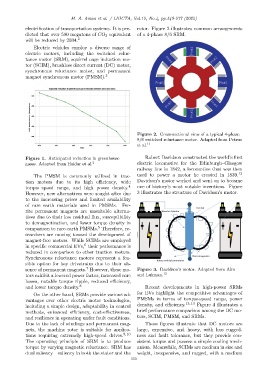
            electrification of transportation systems. It is pre-  rotor. Figure 2 illustrates common arrangements
            dicted that over 500 megatons of CO 2 equivalent  of a 4-phase 8/6 SRM.
            will be reduced by 2034. 2
                Electric vehicles employ a diverse range of
            electric motors, including the switched reluc-
            tance motor (SRM), squirrel cage induction mo-
            tor (SCIM), brushless direct current (DC) motor,
            synchronous reluctance motor, and permanent
            magnet synchronous motor (PMSM).    3


                                                              Figure 2. Cross-sectional view of a typical 4-phase
                                                              8/6 switched reluctance motor. Adapted from Petrus
                                                              et al. 11

            Figure 1. Anticipated reduction in greenhouse         Robert Davidson constructed the world’s first
            gases. Adapted from Haidar et al. 2               electric locomotive for the Edinburgh–Glasgow
                                                              railway line in 1842, a locomotive that was then
                The PMSM is commonly utilized in trac-        used to power a motor he created in 1839.    12
            tion motors due to its high efficiency, wide      Davidson’s motor worked and went on to become
            torque–speed range, and high power density.   4   one of history’s most notable inventions. Figure
            However, new alternatives were sought after due   3 illustrates the structure of Davidson’s motor.
            to the increasing prices and limited availability
            of rare earth materials used in PMSMs.     Fer-
            rite permanent magnets are unsuitable alterna-
            tives due to their low residual flux, susceptibility
            to demagnetization, and lower torque density in
                                             5
            comparison to rare-earth PMSMs. Therefore, re-
            searchers are moving toward the development of
            magnet-free motors. While SCIMs are employed
                                      6
            in specific commercial EVs, their performance is
            reduced in comparison to other traction motors.
            Synchronous reluctance motors represent a fea-
            sible option for key drivetrains due to their ab-
                                       7
            sence of permanent magnets. However, these mo-    Figure 3. Davidson’s motor. Adapted from Ahn
            tors exhibit a lowered power factor, increased core  and Lukman. 12
            losses, notable torque ripple, reduced efficiency,
            and lower torque density. 8                           Recent developments in high-power SRMs
                On the other hand, SRMs provide various ad-   for EVs highlight the competitive advantages of
            vantages over other electric motor technologies,  PMSMs in terms of torque-speed range, power
                                                                                   13,14
            including a simple design, adaptability in control  density, and efficiency.  Figure 4 illustrates a
            methods, enhanced efficiency, cost-effectiveness,  brief performance comparison among the DC mo-
            and resilience in operating under fault conditions.  tors, SCIM, PMSM, and SRMs.
            Due to the lack of windings and permanent mag-        These figures illustrate that DC motors are
            nets, the machine rotor is suitable for applica-  large, expensive, and heavy, with less rugged-
            tions requiring extremely high-speed drives. 9,10  ness and fault tolerance, but they provide con-
            The operating principle of SRM is to produce      sistent torque and possess a simple cooling mech-
            torque by varying magnetic reluctance. SRM has    anism. Meanwhile, SCIMs are medium in size and
            dual saliency—saliency in both the stator and the  weight, inexpensive, and rugged, with a medium
                                                           550

