


Page 10 - IJOCTA-15-4
P. 10
M. A. Aman et al. / IJOCTA, Vol.15, No.4, pp.549-577 (2025)
            2. Fundamentals of switched reluctance            3. Control strategies of switched
                motors                                           reluctance motors

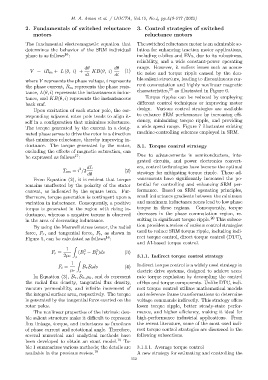
            The fundamental electromagnetic equation that     The switched reluctance motor is an admirable so-
            determines the behavior of the SRM individual     lution for enhancing traction motor applications,
                              16
            phase is as follows :                             including e-bikes and EVs, due to its robustness,
                                                              reliability, and a wide constant-power operating
                                       dθ           dθ        range. However, it suffers issues such as acous-
              V = iR m + L (θ, i) +       KB(θ, i)      (1)
                                       dt           dt        tic noise and torque ripple caused by the dou-
                                                              ble salient structure, leading to discontinuous cur-
            where V represents the phase voltage, i represents
                                                              rent commutation and highly nonlinear magnetic
            the phase current, R m represents the phase resis-
                                                              characteristics, 20  as illustrated in Figure 6.
            tance, L(θ, i) represents the instantaneous induc-
            tance, and KB(θ, i) represents the instantaneous      Torque ripples can be reduced by employing
            back emf.                                         different control techniques or improving motor
                Upon excitation of each stator pole, the cor-  design. Various control strategies are available
            responding adjacent rotor pole tends to align it-  to enhance SRM performance by increasing effi-
            self in a configuration that minimizes reluctance.  ciency, minimizing torque ripple, and providing
            The torque generated by the current in a desig-   a wide speed range. Figure 7 illustrates existing
            nated phase serves to drive the rotor in a direction  machine-controlling schemes employed in SRM.
            that minimizes reluctance, thereby improving in-
            ductance. The torque generated by the motor,      3.1. Torque control strategy
            excluding the effects of magnetic saturation, can
                                  17
            be expressed as follows :                         Due to advancements in semiconductors, inte-
                                                              grated circuits, and power electronics convert-
                                        dL                    ers, control technologies have become the optimal
                                    2
                             T em = i /2                (2)
                                        dθ                    strategy for mitigating torque ripple. These ad-
                From Equation (2), it is evident that torque  vancements have significantly increased the po-
            remains unaffected by the polarity of the stator  tential for controlling and enhancing SRM per-
            current, as indicated by the square term. Fur-    formance. Based on SRM operating principles,
            thermore, torque generation is contingent upon a  small inductance gradients between the minimum
            variation in inductance. Consequently, a positive  and maximum inductance zones lead to low phase
            torque is generated in the region with rising in-  torque in these regions.  Consequently, torque
            ductance, whereas a negative torque is observed   decreases in the phase commutation region, re-
            in the area of decreasing inductance.             sulting in significant torque ripple. 20  This subsec-
                                                              tion provides a review of various control strategies
                By using the Maxwell stress tensor, the radial
                                                              used to reduce SRM torque ripple, including indi-
            force, F r , and tangential force, F t , as shown in
                                                16
            Figure 5, can be calculated as follows :          rect torque control, direct torque control (DTC),
                                                              and AI-based torque control.
                                 Z
                              1       2     2
                        F r =       (B − B )ds          (3)
                                            t
                                      r
                             2µ◦  s                           3.1.1. Indirect torque control strategy
                                 1  Z
                           F t =     B r B t ds         (4)   Indirect torque control is a widely used strategy in
                                µ◦  s                         electric drive systems, designed to achieve accu-
                In Equation (3), B r , B t , µ 0 , and ds represent  rate torque regulation by decoupling the control
            the radial flux density, tangential flux density,  of flux and torque components. Unlike DTC, indi-
            vacuum permeability, and infinite increment of    rect torque control utilizes mathematical models
            the integral surface area, respectively. The torque  and reference frame transformations to determine
            is generated by the tangential force exerted on the  voltage commands indirectly. This strategy offers
            rotor poles.                                      lower torque ripple, better steady-state perfor-
                The nonlinear properties of the intrinsic dou-  mance, and higher efficiency, making it ideal for
            ble salient structure make it difficult to represent  high-performance industrial applications. From
            flux linkage, torque, and inductance as functions  the recent literature, some of the most used indi-
            of phase current and rotational angle. Therefore,  rect torque control strategies are discussed in the
            several numerical and analytical methods have     following subsections.
            been developed to obtain an exact model. 19  Ta-
            ble 1 summarizes various methods; the details are  3.1.1.1. Average torque control
            available in the previous review. 19              A new strategy for estimating and controlling the
                                                           552

