


Page 12 - IJOCTA-15-4
P. 12
M. A. Aman et al. / IJOCTA, Vol.15, No.4, pp.549-577 (2025)
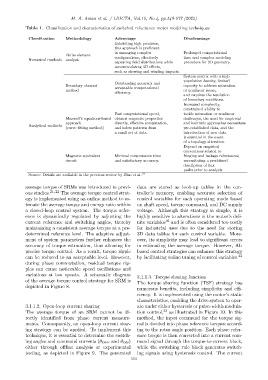
            Table 1. Classification and characteristics of switched reluctance motor modeling techniques

              Classification  Methodology           Advantage                      Disadvantage
                                                    Exhibiting high precision,
                                                    this approach is proficient
                                                    in managing complex            Prolonged computational
                              Finite element
              Numerical methods analysis            configurations, effectively    time and complex modeling
                                                    capturing field distributions while  procedure for 3D geometry.
                                                    accommodating 3D effects,
                                                    such as skewing and winding impacts.
                                                                                   System matrix with a high
                                                                                   population density, limited
                                                    Outstanding accuracy and
                              Boundary element      acceptable computational       capacity to address saturation
                              method                                               or nonlinear issues,
                                                    efficiency.
                                                                                   and requires the resolution
                                                                                   of boundary conditions.
                                                                                   Increased complexity,
                                                                                   constrained ability to
                                                    Fast computational speed,      tackle saturation or nonlinear
                              Maxwell’s equations-based obtains magnetic properties  challenges, the need for empirical
                              approach              directly, effective computation,  and heuristic approaches necessitate
              Analytical methods
                              (curve fitting method)  and infers patterns from     pre-established data, and the
                                                    a small set of data.           introduction of new data
                                                                                   is essential in the event
                                                                                   of a topology alteration.
                                                                                   Depend on empirical
                                                                                   conventions related to
                              Magnetic equivalent   Minimal computation time       fringing and leakage reluctances,
                              circuit               and satisfactory accuracy.     necessitating a predefined
                                                                                   description of flux
                                                                                   paths prior to analysis.
              Source: Details are available in the previous review by Diao et al. 19

            average torque of SRMs was introduced in previ-   data are stored as look-up tables in the con-
            ous studies. 21,22  The average torque control strat-  troller’s memory, enabling accurate selection of
            egy is implemented using an online method to es-  control variables for each operating mode based
            timate the average torque and energy ratio within  on shaft speed, torque command, and DC supply
            a closed-loop control system. The torque refer-   voltage. Although this strategy is simple, it is
            ence is dynamically regulated by adjusting the    highly sensitive to alterations in the motor’s defi-
            current reference and switching angles, thereby   nite variables 16  and is often considered too costly
            maintaining a consistent average torque at a pre-  for industrial uses due to the need for storing
            determined reference level. The adaptive adjust-  3D data tables for each control variable. More-
            ment of system parameters further enhances the    over, its simplicity may lead to significant errors
            accuracy of torque estimation, thus allowing for  in estimating the average torque. However, AI-
            precise torque control. As a result, torque ripple  based control strategies can enhance this strategy
            can be reduced to an acceptable level. However,   by facilitating online tuning of control variables. 23
            during phase commutation, residual torque rip-
            ples can cause noticeable speed oscillations and
            variations at low speeds. A schematic diagram     3.1.1.3. Torque sharing function
            of the average torque control strategy for SRM is  The torque sharing function (TSF) strategy has
            depicted in Figure 8.
                                                              numerous benefits, including simplicity and effi-
                                                              ciency. It is implemented using the motor’s static
                                                              characteristics, enabling the drive system to oper-
            3.1.1.2. Open-loop current sharing                ate under either hysteresis or pulse-width modula-
            The average torque of an SRM cannot be di-        tion control, 23  as illustrated in Figure 10. In this
            rectly identified from phase current measure-     method, the input command for the torque sig-
            ments. Consequently, an open-loop current shar-   nal is divided into phase reference torques accord-
            ing strategy can be applied. To implement this    ing to the rotor angle position. Each phase refer-
            technique, it is essential to determine the switch-  ence torque is then converted into a current com-
            ing angles and command currents (θ OFF and θ ON )  mand signal through the torque-to-current block,
            either through offline analysis or experimental   while the switching rule block generates switch-
            testing, as depicted in Figure 9. The generated   ing signals using hysteresis control. The current
                                                           554

