


Page 14 - IJPS-1-1
P. 14
Changes in total and disability-free life expectancy among older adults in China: Do they portend a compression of morbidity?
highest achieved level of education. We create a dichotomous variable for education that
makes sense, given the distributions of education among this cohort. The categories are:
primary or less, estimated as being 4 or fewer years of schooling; and more than primary,
estimated as 5+ years. From this point on we refer to this delineation simply as lower edu-
cated and higher educated.
2.3 Analytical Strategy
The Sullivan method is used for computing DFLE (Saito et al., 2014; Sullivan, 1971; Jag-
ger et al., 2014). The method customarily applies disability prevalence rates from a sample
survey to published life tables to compute DFLE. However, this limits comparisons to
groups that are identified in published life tables. Since no life tables for China divide the
population into rural/urban by education sub-groups, we use a technique employed by
Chiu (2013) where both the life table and disability prevalence rates are derived from
sample surveys.
TLE is determined from survival models that have an exponential distribution computed
with SAS software and its PROC LIFEREG procedure. The equation first estimates the
hazard of dying as a function of sex and age. The second estimates the hazards adding co-
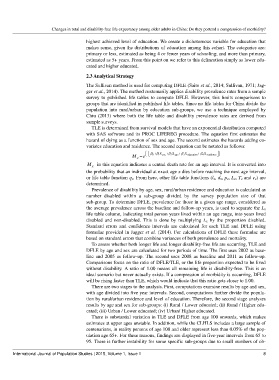
variates education and residence. The second equation can be notated as follows:
e
M = ( 0 β β + 1 X sex β + 2 X age β + 3 X education β + 4 X residence ) −
x
M in this equation indicates a central death rate for an age interval. It is converted into
x
the probability that an individual at exact age x dies before reaching the next age interval,
or life table function q x. From here, other life table functions (l x, d x, p x, L x, T x and e x) are
determined.
Prevalence of disability by age, sex, rural/urban residence and education is calculated as
number disabled within a sub-group divided by the survey population size of that
sub-group. To determine DFLE, prevalence for those in a given age range, considered as
the average prevalence across the baseline and follow-up years, is used to separate the L x
life table column, indicating total person years lived within an age range, into years lived
disabled and non-disabled. This is done by multiplying L x by the proportion disabled.
Standard errors and confidence intervals are calculated for each TLE and DFLE using
formulae provided in Jagger et al. (2014). For calculations of DFLE these formulae are
based on standard errors that combine variances of both prevalence and mortality.
To assess whether both longer life and longer disability-free life are occurring, TLE and
DFLE by age and sex are calculated for two periods of time. The first uses 2002 as base-
line and 2005 as follow-up. The second uses 2008 as baseline and 2011 as follow-up.
Comparisons focus on the ratio of DFLE/TLE, or the life proportion expected to be lived
without disability. A ratio of 1.00 means all remaining life is disability-free. This is an
ideal scenario but never actually exists. If a compression of morbidity is occurring, DFLE
will be rising faster than TLE, which would indicate that this ratio gets closer to 1.00.
There are two stages to the analysis. First, computations examine results by age and sex,
with age divided into five year intervals. Second, computations further divide the popula-
tion by rural/urban residence and level of education. Therefore, the second stage analyzes
results by age and sex for sub-groups: (i) Rural / Lower educated; (ii) Rural / Higher edu-
cated; (iii) Urban / Lower educated; (iv) Urban/ Higher educated.
There is substantial variation in TLE and DFLE from age 100 onwards, which makes
estimates at upper ages unstable. In addition, while the CLHLS includes a large sample of
centenarians, in reality persons of age 100 and older represent less than 0.05% of the pop-
ulation age 65+. For these reasons, findings are displayed in five-year intervals from 65 to
95. There is further instability for some specific sub-groups due to small numbers of ob-
International Journal of Population Studies | 2015, Volume 1, Issue 1 8

