Page 51 - IJPS-1-1
P. 51

Giambattista Salinari and Gustavo De Santis

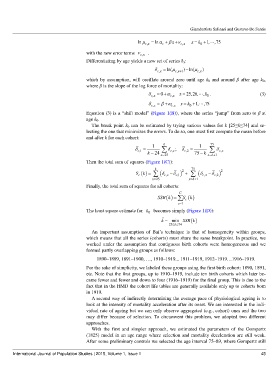
                                                            ln µ  , c x  lnα =  c  β +  x ν +  , c x  x k=  0  +  1, ,75

                                      with the new error terms  ν , c x   .
                                      Differentiating by age yields a new set of series δ x:

                                                                   δ  , c x  = ln(µ  , c x+ 1 ) ln(µ  −  , c x )
                                      which by  assumption, will oscillate around zero until age k 0 and around β after age k 0,
                                      where β is the slope of the log force of mortality:
                                                                δ  , c x  =  0 ω  +  , c x  x =  25,26, ,k  0 .   (3)

                                                                δ   =  βω+    x k=  +  1, ,75
                                                                  , c x    , c x  0
                                      Equation (3) is a “shift model” (Figure 1(B)), where the series “jump” from zero to β at
                                      age k 0.
                                        The break point k 0 can be estimated by trying various values for k [25≤k≤74] and se-
                                      lecting the one that minimizes the errors. To do so, one must first compute the mean before
                                      and after k for each cohort:
                                                                  1    k              1    75
                                                                                          ∑
                                                                      ∑
                                                           δ  c ,1  =  k −  24  x= 25 δ  , c x ; δ  c ,2  =  75 k  x k+ 1 δ  , c x
                                                                                      −
                                                                                          =
                                      Then the total sum of squares (Figure 1(C)):
                                                                   k           2   75          2
                                                           Sk     ∑  ( c ,x  −  δ c ,1 ) +  ∑  ( c ,x  −  δ c ,2 )
                                                                                      δ
                                                                      δ
                                                             ( ) =
                                                            c
                                                                                  =
                                                                  x= 25           x k+ 1
                                      Finally, the total sum of squares for all cohorts:
                                                                             C
                                                                    SSR ( ) k = ∑ S c ( ) k
                                                                             c= 1
                                      The least square estimate for  k   becomes simply (Figure 1(D)):
                                                                0
                                                                      ˆ
                                                                      k =  min SSR ( ) k
                                                                         25 k≤≤ 74
                                        An important assumption  of  Bai’s technique is  that of homogeneity  within  groups,
                                      which means that all the series (cohorts) must share the same breakpoint. In practice, we
                                      worked under the assumption that contiguous birth cohorts were homogeneous and we
                                      formed partly overlapping groups as follows:
                                          1890–1899, 1891–1900, …, 1910–1919... 1911–1919, 1912–1919…1916–1919.
                                      For the sake of simplicity, we labeled these groups using the first birth cohort: 1890, 1891,
                                      etc. Note that the first groups, up to 1910–1919, include ten birth cohorts which later be-
                                      came fewer and fewer and down to four (1916–1919) for the final group. This is due to the
                                      fact that in the HMD the cohort life tables are generally available only up to cohorts born
                                      in 1919.
                                        A second way of indirectly determining the average pace of physiological ageing is to
                                      look at the intensity of mortality acceleration after its onset. We are interested in the indi-
                                      vidual rate of ageing but we can only observe aggregated (e.g., cohort) ones and the two
                                      may differ because of selection. To circumvent this problem, we adopted two different
                                      approaches.
                                        With the first and simpler approach, we estimated the parameters of the Gompertz
                                      (1825) model in an age range where selection and mortality deceleration are still weak.
                                      After some preliminary controls we selected the age interval 75–89, where Gompertz still

       International Journal of Population Studies | 2015, Volume 1, Issue 1                                    45
   46   47   48   49   50   51   52   53   54   55   56