


Page 53 - IJPS-1-1
P. 53
Giambattista Salinari and Gustavo De Santis

                                      WLS as opposed to OLS (ordinary LS) reduces the risk of bias due to heteroscedasticity
                                      (Horiuchi and Coale, 1990; Horiuchi and Wilmoth, 1998).
                                      3. Results

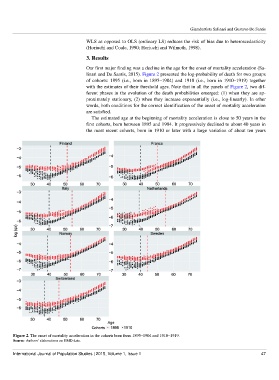
                                      Our first major finding was a decline in the age for the onset of mortality acceleration (Sa-
                                      linari and De Santis, 2015). Figure 2 presented the log-probability of death for two groups
                                      of cohorts: 1895 (i.e., born in 1895–1904) and 1910 (i.e., born in 1910–1919) together
                                      with the estimates of their threshold ages. Note that in all the panels of Figure 2, two dif-
                                      ferent phases in the evolution of the death probabilities emerged: (1) when they are ap-
                                      proximately stationary, (2) when they increase exponentially (i.e., log-linearly). In other
                                      words, both conditions for the correct identification of the onset of mortality acceleration
                                      are satisfied.
                                        The estimated age at the beginning of mortality acceleration is close to 50 years in the
                                      first cohorts, born between 1895 and 1904. It progressively declined to about 40 years in
                                      the  most recent cohorts, born in 1910 or later with a large  variation of about ten  years


       Figure 2. The onset of mortality acceleration in the cohorts born from 1895–1904 and 1910–1919.
       Source: Authors’ elaborations on HMD data.

       International Journal of Population Studies | 2015, Volume 1, Issue 1                                    47

