


Page 55 - IJPS-1-1
P. 55
Giambattista Salinari and Gustavo De Santis


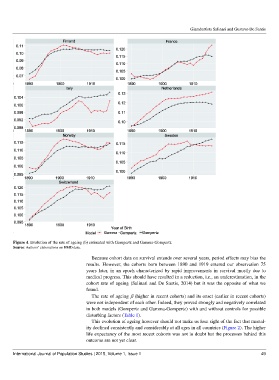
       Figure 4. Evolution of the rate of ageing (b) estimated with Gompertz and Gamma-Gompertz.
       Source: Authors’ elaborations on HMD data.

                                        Because cohort data on survival extends over several years, period effects may bias the
                                      results. However, the cohorts born between 1890 and 1919 entered our observation 75
                                      years later, in an epoch characterized by rapid improvements in survival  mostly  due to
                                      medical progress. This should have resulted in a reduction, i.e., an underestimation, in the
                                      cohort rate of ageing (Salinari and De Santis, 2014) but it was the opposite of what we
                                      found.
                                        The rate of ageing β (higher in recent cohorts) and its onset (earlier in recent cohorts)
                                      were not independent of each other. Indeed, they proved strongly and negatively correlated
                                      in both models (Gompertz and Gamma-Gompertz) with and without controls for possible
                                      disturbing factors (Table 1).
                                        This evolution of ageing however should not make us lose sight of the fact that mortal-
                                      ity declined consistently and considerably at all ages in all countries (Figure 2). The higher
                                      life expectancy of the most recent cohorts was not in doubt but the processes behind this
                                      outcome are not yet clear.

       International Journal of Population Studies | 2015, Volume 1, Issue 1                                    49

