


Page 56 - IJPS-1-1
P. 56
Earlier and more rapid ageing: Does nutrition contribute?

       Table 1. Regressing the onset of ageing on the rate of ageing.
                                        Gompertz                                    Gamma-Gompertz
                       Without controls   Controlling for cohort and country   Without controls   Controlling for cohort and country
       Intercept          66***                  61***                     76***                 66***
       Rate of ageing   –193***                –166**                    –294***                –224***
        2
       R                   0.28                   0.83                     0.38                   0.83
         ** p < 0.01, *** p < 0.001,
         Source: Authors’ computation on HMD Data.

                                      3.1 Comparing Our Results with the Outcomes of the Calorie Restriction Experi-
                                      ments
                                      If an acceleration of physiological ageing did indeed occur over time, it seems natural to
                                      wonder why. We do not know the answer, but we submit that the changed nutritional ha-
                                      bits may have possibly played a major part in all this.
                                        The relationship between nutrition and  mortality has always interested demographers
                                      since the times of Malthus (1798). In the last two to three decades, calorie restriction ex-
                                      periments on animals have improved our knowledge because when the external (disturbing)
                                      factors are kept under control or altogether eliminated, the role of nutrition can be better
                                      understood. What holds for animals may hold for humans too or at least give some insights
                                      into the process.
                                        The first experiment of calorie restriction (CR) on rats dating back to the 1930s by
                                      McCay et al. (Masoro, 2005), led to the counter-intuitive conclusion that a restriction in
                                      food intake resulted in an extension of the rats’ lives. However, these results did not attract
                                      much attention until the 1980s when they were confirmed by other similar experiments.
                                      CR experiments have been carried out on yeast (Jiang, Jaruga and Repnevskaya, 2000),
                                      fruit flies (Bross, Rogina and Helfand, 2005; Mair, Goymer, Pletcher et al., 2003), nema-
                                      todes (Houthoofd, Braeckman, Lenaerts et al., 2002; Lenaerts, van Eygen and van Fleteren,
                                      2007; Yen and Mobbs, 2008), crustaceans (Ingle, Wood and Banta, 1937), spiders (Austad,
                                      1989), rodents  (Masoro, 2005; 2009), dogs (Kealy,  Lawler, Ballam  et al., 2002), cattle
                                      (Pinney, Stephens and Pope, 1972), primates (Bodkin, Alexander, Ortmeyer et al., 2003;
                                      Colman, Anderson, Johnson et al., 2009; Colman, Beasley, Kemnitz et al., 2014; Mattison,
                                      Roth, Beasley et al., 2012), and occasionally even on humans (Bartke, 2012; Holloszy and
                                      Fontana, 2007; Longo and Fontana, 2009; Roth and Polotsky, 2012).
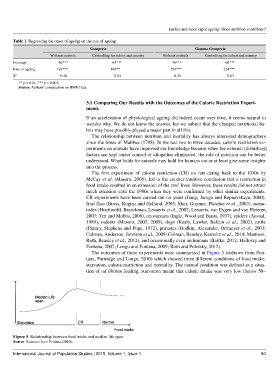
                                        The outcomes of these experiments were summarized in Figure 5 (redrawn from Fon-
                                      tana, Partridge and Longo, 2010) which showed three different conditions of food intake:
                                      starvation, calorie restriction and normality. The normal condition was defined as a situa-
                                      tion of ad libitum feeding, starvation meant that caloric intake was very low (below 50–


       Figure 5. Relationship between food intake and median life span.
       Source: Redrawn from Fontana (2010).

       International Journal of Population Studies | 2015, Volume 1, Issue 1                                    50

