


Page 54 - IJPS-2-2
P. 54
Latent class models for cross-national comparisons: the association between individual and national-level fertility and partnership characteristics


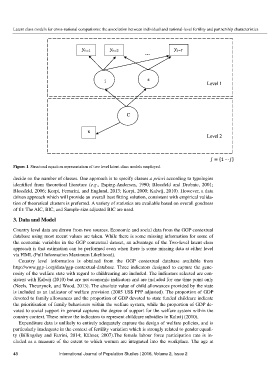
       Figure 1. Structural equation representation of two level latent class models employed.

       decide on the number of classes. One approach is to specify classes a priori according to typologies
       identified from theoretical  literature (e.g., Esping-Andersen,  1990; Blossfeld and Drobnic,  2001;
       Blossfeld, 2006; Korpi, Ferrarini, and Englund, 2013; Korpi, 2000; Kalwij, 2010). However, a data
       driven approach which will provide an overall best fitting solution, consistent with empirical valida-
       tion of theoretical clusters is preferred. A variety of statistics are available based on overall goodness
       of fit: The AIC, BIC, and Sample-size adjusted BIC are used.
       3. Data and Model

       Country level data are drawn from two sources. Economic and social data from the GGP contextual
       database using most recent values are taken. While there is some missing information for some of
       the economic variables in the GGP contextual dataset, an advantage of the Two-level latent class
       approach is that estimation can be performed even when there is some missing data at either level
       via FIML (Full Information Maximum Likelihood).
         Country level information is  obtained from the GGP contextual database  available from
       http://www.ggp-i.org/data/ggp-contextual-database.  Three indicators designed to capture the gene-
       rosity of the welfare state with regard to childrearing are included. The indicators selected are con-
       sistent with Kalwij (2010) but are not economic indicators and are included for one time point only
       (Neels, Theunynck, and Wood, 2013). The absolute value of child allowances provided by the state
       is included as an indicator of welfare provision (2005 US$ PPP adjusted). The proportion of GDP
       devoted to family allowances and the proportion of GDP devoted to state funded childcare indicate
       the prioritisation of family behaviours within the welfare system, while the proportion of GDP de-
       voted to social support in general captures the degree of support for the welfare system within the
       country context. These mirror the indicators to represent childcare subsidies in Kalwij (2010).
         Expenditure data is unlikely to entirely adequately capture the design of welfare policies, and is
       particularly inadequate in the context of fertility variation which is strongly related to gender equali-
       ty (Billingsley and Farrini, 2014; Kühner,  2007).The female labour  force  participation rate  is in-
       cluded as a measure of the extent to which women are integrated into the workplace. The age at

       48                 International Journal of Population Studies | 2016, Volume 2, Issue 2

