


Page 56 - IJPS-2-2
P. 56
Latent class models for cross-national comparisons: the association between individual and national-level fertility and partnership characteristics
trends such as divorce/union dissolution or the transition of cohabitation into marriage. In contrast,
F
entry into motherhood y is modelled as a cumulative growth curve (consistent with Dariotis,
tj
Pleck, Astone, et al., 2011). This is reflected in Equation 1. The probability of being married, in a
cohabiting relationship and having ever had a first birth is a function of a third order polynomial of
the age of the respondent dependent on membership of class J.
( ) = logit y M age + β M age 2 + β β M age 3
M
tj tj t t
C
( ) = logit y M age t +β C age 2 t + β β C age t 3 (1)
tj
( )
logit y M = β F age + M age 2,F + β β M age 3
tj t t t
J = { 1 } j
4. Results
4.1 Class Characteristics
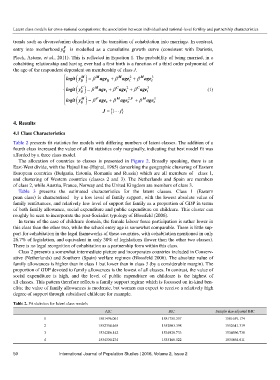
Table 2 presents fit statistics for models with differing numbers of latent classes. The addition of a
fourth class increased the value of all fit statistics only marginally, indicating that best model fit was
afforded by a three class model.
The allocation of countries to classes is presented in Figure 2. Broadly speaking, there is an
East-West divide, with the Hajnal line (Hajnal, 1965) demarking the geographic clustering of Eastern
European countries (Bulgaria, Estonia, Romania and Russia) which are all members of class 1,
and clustering of Western countries (classes 2 and 3). The Netherlands and Spain are members
of class 2, while Austria, France, Norway and the United Kingdom are members of class 3.
Table 3 presents the estimated characteristics for the latent classes. Class 1 (Eastern
pean class) is characterised by a low level of family support, with the lowest absolute value of
family remittances, and relatively low level of support for family as a proportion of GDP in terms
of both family allowance, social expenditure and public expenditure on childcare. This cluster can
roughly be seen to incorporate the post-Socialist typology of Blossfeld (2006).
In terms of the ease of childcare domain, the female labour force participation is rather lower in
this class than the other two, while the school entry age is somewhat comparable. There is little sup-
port for cohabitation in the legal frameworks of these countries, with cohabitation mentioned in only
26.7% of legislation, and equivalent in only 30% of legislations (lower than the other two classes).
There is no legal recognition of cohabitation as a partnership form within this class.
Class 2 presents a somewhat intermediate picture and incorporates countries included in Conserv-
ative (Netherlands) and Southern (Spain) welfare regimes (Blossfeld 2006). The absolute value of
family allowances is higher than in class 1 but lower than in class 3 (by a considerable margin). The
proportion of GDP devoted to family allowances is the lowest of all classes. In contrast, the value of
social expenditure is high, and the level of public expenditure on childcare is the highest of
all classes. This pattern therefore reflects a family support regime which is focussed on in-kind ben-
efits; the value of family allowances is moderate, but women can expect to receive a relatively high
degree of support through subsidised childcare for example.
Table 2. Fit statistics for latent class models
AIC BIC Sample size adjusted BIC
1 1581496.061 1581751.337 1581659.174
2 1552354.465 1552803.398 1552641.319
3 1534286.142 1534928.733 1534696.738
4 1534330.274 1535166.522 1534864.611
50 International Journal of Population Studies | 2016, Volume 2, Issue 2

