


Page 58 - IJPS-2-2
P. 58
Latent class models for cross-national comparisons: the association between individual and national-level fertility and partnership characteristics

       GDP. General social expenditure is high, although the support for childcare as a proportion of GDP
       is somewhat lower than in class 2 and consistent with Eastern European levels. Female labour force
       participation is in excess of 70%, albeit slightly lower than in class 2. The school entry is the lowest
       seen in all classes.
         In general this class  demonstrates a  high  degree  of support for  cohabitation within the legal
       frameworks of countries. Cohabitation is mentioned in nearly one third of relevant laws, and legally
       equivalent in nearly 35% of these. The existence of a legally recognised cohabiting relationship is
       highly prevalent for countries in this class, with a near universal existence of a formal non-marital
       union within the law.

       4.2 Individual Characteristics

       Growth curves for three demographic processes were extracted, with the growth curve varying by
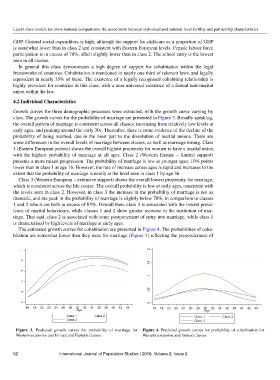
       class. The growth curves for the probability of marriage are presented in Figure 3. Broadly speaking,
       the overall pattern of marriage is consistent across all classes, increasing from relatively low levels at
       early ages, and peaking around the early 30s. Thereafter, there is some evidence of the decline of the
       probability of being married, due in the most part to the dissolution of marital unions. There are
       some differences in the overall levels of marriage between classes, as well as marriage timing. Class
       1 (Eastern European pattern) shows the overall highest propensity for women to have a marital union,
       with the  highest  probability of marriage at all ages.  Class  2 (Western Europe  –  limited support)
       presents a more mixed progression. The probability of marriage is low at younger ages; 10% points
       lower than in class 1 at age 16. However, the rate of increase across ages is rapid and increases to the
       extent that the probability of marriage is nearly at the level seen in class 1 by age 36.
         Class 3 (Western European – extensive support) shows the overall lowest propensity for marriage,
       which is consistent across the life course. The overall probability is low at early ages, consistent with
       the levels seen in class 2. However, in class 3 the increase in the probability of marriage is not as
       dramatic, and the peak in the probability of marriage is slightly below 70%, in comparison to classes
       1 and 2 which are both in excess of 85%. Overall then, class 3 is associated with the lowest preva-
       lence of marital behaviours, while classes 1 and 2 show greater recourse to the institution of mar-
       riage. That said, class 2 is associated with some postponement of entry into marriage, while class 1
       is characterised by high levels of marriage at early ages.
         The estimated growth curves for cohabitation are presented in Figure 4. The probabilities of coha-
       bitation are somewhat lower than they were for marriage (Figure 3) reflecting the preponderance of


        Figure 3.  Predicted growth  curves for probability  of marriage for  Figure 4. Predicted growth curves for probability of cohabitation for
        Western extensive and limited and Eastern classes.    Western extensive and limited classes.


       52                 International Journal of Population Studies | 2016, Volume 2, Issue 2

