


Page 55 - IJPS-2-2
P. 55
Mark Lyons-Amos

                             starting school is also included as a measure of how easy it is to combine childbearing with work,
                             due to rising female employment and increased difficulty in fulfilling multiple roles influencing fer-
                             tility outcomes (Mason, 1998; McDonald, 2000; Mills, 2010). The effect of the interaction between
                             leave provision (as well as other indicators of the integration of women into the labour market post
                             childbearing) and fertility and partnership behaviour is widely documented (Adserà, 2004; Ahn and
                             Mira, 2002; Chesnais, 1996; Neyer, 2003) as well as the broader social contexts within which both
                             demographic behaviour and policy formation occur (McDonald, 2000).
                                Measures on the legal status of cohabitation is also included (Perelli-Harris and Sánchez-Gassen,
                             2012). Specifically, the proportion of policies in which cohabitation was mentioned and the propor-
                             tion of policies in which marriage and cohabitation were afforded equal status are used. Finally, a
                             binary indicator of whether the country in question has a legally recognised cohabiting state distinct
                             from marriage is included (e.g., PACS).
                                Individual level data for this analysis are drawn from the Harmonized Histories (Perelli-Harris,
                             Kreyenfeld, and Kubisch, 2010, and see www.nonmarital.org where the data can also be requested).
                             The Harmonized Histories is a dataset  containing  consistent retrospective demographic  histories
                             from 16 countries across Europe based largely on GGP surveys (as well as some other national surveys).
                                A subset of 10 countries from the full Harmonized Histories dataset is extracted to ensure that
                             each country in the dataset has at least some contextual level information available. Therefore, res-
                             pondents from Austria, Bulgaria, Estonia, France, the Netherlands, Norway, Romania, Russia, Spain,
                             and the United Kingdom are selected since these countries have at least some information available
                             either from the GGP contextual database (or comparable source) or the study by Perelli-Harris and
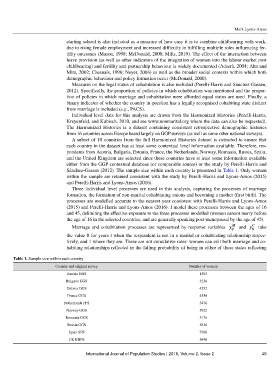
                             Sánchez-Gassen (2012). The sample size within each country is presented in Table 1. Only women
                             within the sample are retained consistent with the study by Perelli-Harris and Lyons-Amos (2015)
                             and Perelli-Harris and Lyons-Amos (2016).
                                Three individual level processes are used in this analysis, capturing the processes of  marriage
                             formation, the formation of non-marital cohabitating unions and becoming a mother (first birth). The
                             processes are modelled accurate to the nearest year consistent with Perelli-Harris and Lyons-Amos
                             (2015) and Perelli-Harris and Lyons-Amos (2016). I model these processes between the ages of 16
                             and 45, delimiting the effective exposure to the three processes modelled (women cannot marry before
                             the age of 16 in the selected countries, and are generally speaking post-menopausal by the age of 45).
                                                                                                            C
                                                                                                    M
                                Marriage and  cohabitation processes  are  represented by  response variables  y   and  y   take
                                                                                                            tj
                                                                                                    tj
                             the value 0 for years t when the respondent is not in a marital or cohabitating relationship respec-
                             tively, and 1 where they are. These are not cumulative rates: women can exit both marriage and co-
                             habiting relationships reflected in the falling probability of being in either of these states reflecting

       Table 1. Sample size within each country
                         Country and original survey                             Number of women
                             Austria GGS                                              1505
                             Bulgaria GGS                                             5236
                             Estonia GGS                                              4252
                              France GGS                                              4556
                            Netherlands FFS                                           3476
                             Norway GGS                                               5922
                             Romania GGS                                              5176
                              Russia GGS                                              5836
                              Spain SFS                                               7300
                              UK BHPS                                                 5890

                                     International Journal of Population Studies | 2016, Volume 2, Issue 2      49

