


Page 57 - IJPS-2-2
P. 57
Mark Lyons-Amos


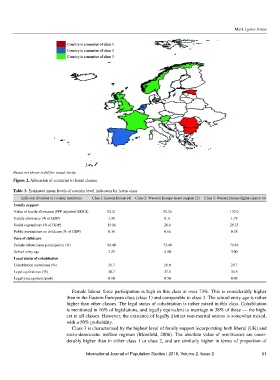
       Russia not shown in full for visual clarity.

       Figure 2. Allocation of countries to latent classes.

       Table 3. Estimated mean levels of country level indicators by latent class
          Indicator (Number of country members)   Class 1: Eastern Europe (4)  Class 2: Western Europe lesser support (2)   Class 3: Western Europe higher support (4)
       Family support
       Value of family allowance (PPP adjusted 2005 $)   82.21        92.26                        133.0
       Family allowance (% of GDP)             1.38                    0.11                        1.78
       Social expenditure (% of GDP)           13.16                   26.8                        26.13
       Public expenditure on childcare (% of GDP)   0.38               0.64                        0.38
       Ease of childcare
       Female labour force participation (%)   64.40                  73.40                        70.46
       School entry age                        3.25                    4.00                        3.00
       Legal status of cohabitation
       Cohabitation mentioned (%)              26.7                    26.0                        29.7
       Legal equivalence (%)                   30.7                    37.5                        34.5
       Legally recognised (prob)               0.00                    0.50                        0.99

                                Female labour force participation is high in this class at over 73%. This is considerably higher
                             than in the Eastern European class (class 1) and comparable to class 3. The school entry age is rather
                             higher than other classes. The legal status of cohabitation is rather mixed in this class. Cohabitation
                             is mentioned in 16% of legislations, and legally equivalent to marriage in 38% of these — the high-
                             est in all classes. However, the existence of legally distinct non-marital unions is somewhat mixed,
                             with a 50% probability.
                                Class 3 is characterised by the highest level of family support incorporating both liberal (UK) and
                             socio-democratic welfare regimes (Blossfeld, 2006). The absolute value of remittances are consi-
                             derably higher than in either class 1 or class 2, and are similarly higher in terms of proportion of

                                     International Journal of Population Studies | 2016, Volume 2, Issue 2      51

