


Page 59 - IJPS-2-2
P. 59
Mark Lyons-Amos

                             formalised unions across all classes. The probability of living in a cohabiting relationship follows a
                             similar trajectory for both  class  1 (Eastern European)  and class  2 (Western European  —  limited
                             support). There is a gentle increase in the probability of cohabitation, reaching a peak around age 30
                             at approximately 5%. Thereafter, there is a fall in the probability of being in a cohabiting union, to
                             just over 1% in class 2, while the probability remains above 3% in class 1. This reflects that in East-
                             ern Europe and Western regimes with limited social support the probability of being in a non-marital
                             union is still low.
                                In contrast the probability of cohabitation is considerably higher in class 3 (Western European –
                             extensive support), increasing to peak at age 30 at around 11% (more than double the other classes).
                             Thereafter the probability of cohabitation decreases rapidly, falling to around 3% by the age of 45.
                             This is  indicative that the Western European regimes with  high  levels  of social support  are
                             more characterised by non-marital partnership behaviour.
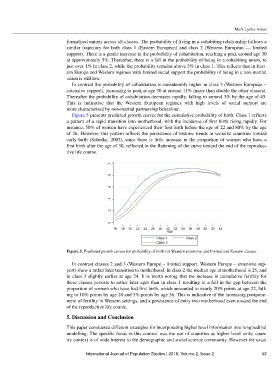
                                Figure 5 presents predicted growth curves for the cumulative probability of birth. Class 1 reflects
                             a pattern of a rapid transition into motherhood, with the incidence of first birth rising rapidly. For
                             instance, 50% of women have experienced their first birth before the age of 22 and 80% by the age
                             of 26. However, this pattern reflects the persistence of historic trends in socialist countries toward
                             early birth (Sobotka, 2003), since there is little increase in the proportion of women who have a
                             first birth after the age of 30, reflected in the flattening of the curve toward the end of the reproduc-
                             tive life course.


                             Figure 5. Predicted growth curves for probability of birth for Western extensive and limited and Eastern classes.

                                In contrast classes 2 and 3 (Western Europe – limited support, Western Europe – extensive sup-
                             port) show a rather later transition to motherhood. In class 2 the median age at motherhood is 25, and
                             in class 3 slightly earlier at age 24. It is worth noting that the increase in cumulative fertility for
                             these classes persists to rather later ages than in class 1 resulting in a fall in the gap between the
                             proportion of women who have had first birth, which amounted to nearly 20% points at age 22, fall-
                             ing to 10% points by age 28 and 5% points by age 36. This is indicative of the increasing postpone-
                             ment of fertility in Western settings, and a persistence of entry into motherhood even toward the end
                             of the reproductive life course.
                             5. Discussion and Conclusion

                             This paper considered different strategies for incorporating higher level information into longitudinal
                             modelling. The specific focus in this context was the use of countries as higher level units: coun-
                             try context is of wide interest to the demographic and social science community. However the usual


                                     International Journal of Population Studies | 2016, Volume 2, Issue 2      53

