


Page 90 - IJPS-2-2
P. 90
Self-rated health and interviewer-rated health: differentials in predictive power for mortality among subgroups of Chinese elders

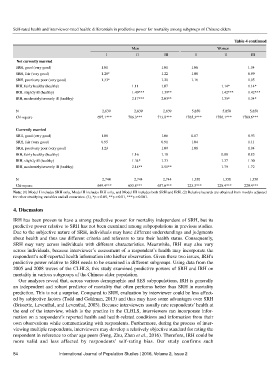
                                                                                                     Table 4 continued
                                                         Men                                 Women
                                              I            II          III          I            II         III
        Not currently married
        SRH, good (very good)               1.01                      1.01        1.06                     1.04
        SRH, fair (very good)               1.26*                     1.22        1.06                     0.99
        SRH, poor/very poor (very good)     1.33*                     1.20        1.16                     1.05
        IRH, fairly healthy (healthy)                    1.11         1.07                     1.14*       1.14*
        IRH, slightly ill (healthy)                      1.49***      1.39**                   1.42***     1.42***
        IRH, moderately/severely ill (healthy)           2.17***      2.03**                   1.35*       1.34*

        N                                    2,639        2,639         2,639      5,850         5,850      5,850
        Chi-square                         697.1***     706.3***    713.8***    1765.3***    1786.1***   1789.6***

        Currently married
        SRH, good (very good)               1.08                      1.06        0.87                     0.93
        SRH, fair (very good)               0.95                      0.91        1.04                     1.11
        SRH, poor/very poor (very good)     1.23                      1.09        1.08                     1.04
        IRH, fairly healthy (healthy)                    1.16         1.18                     0.88        0.85
        IRH, slightly ill (healthy)                      1.34*        1.33                     1.37        1.30
        IRH, moderately/severely ill (healthy)           2.14**       2.91**                   1.79        1.72

        N                                   2,744         2,744         2,744      1,350         1,350      1,350
        Chi-square                         649.4***     653.8***    657.6***     223.3***     228.4***   229.4***
       Note: (1) Model I includes SRH only, Model II includes IRH only, and Model III includes both SRH and IRH. (2) Relative hazards are obtained from models adjusted
       for other stratifying variables and all covariates. (3), *p < 0.05, **p < 0.01, ***p < 0.001.

       4. Discussion

       IRH has been proven to have a strong predictive power for mortality independent of SRH, but its
       predictive power relative to SRH has not been examined among subpopulations in previous studies.
       Due to the subjective nature of SRH, individuals may have different understandings and judgments
       about health and thus use different criteria and referents to rate their health status. Consequently,
       SRH  may vary across individuals with  different characteristics. Meanwhile, IRH  may also vary
       across individuals, because interviewer’s assessment of a respondent’s health may incorporate the
       respondent’s self-reported health information into his/her observation. Given these two issues, IRH’s
       predictive power relative to SRH needs to be examined in different subgroups. Using data from the
       2005 and 2008 waves of the CLHLS, this study examined predictive powers of SRH and IRH on
       mortality in various subgroups of the Chinese older population.
         Our analyses reveal that, across various demographic and SES subpopulations, IRH is generally
       an independent and robust predictor of mortality that often performs better than SRH in mortality
       prediction. This is not a surprise. Compared to SRH, evaluation by interviewer could be less affect-
       ed by subjective factors (Todd and Goldman, 2013) and thus may have some advantages over SRH
       (Brissette, Leventhal, and Leventhal, 2003). Because interviewers usually rate respondents’ health at
       the end of the interview, which is the practice in the CLHLS, interviewers can incorporate infor-
       mation on a respondent’s reported health and health-related conditions and information from their
       own observations while communicating with respondents. Furthermore, during the process of inter-
       viewing multiple respondents, interviewers may develop a relatively objective standard for rating the
       respondent in reference to other age peers (Feng, Zhu, Zhen et al., 2016). Therefore, IRH could be
       more  valid  and  less affected by  respondents’  self-rating  bias. Our study confirms such

       84                 International Journal of Population Studies | 2016, Volume 2, Issue 2

