


Page 63 - IMO-2-1
P. 63
Innovative Medicines & Omics Flavonoids against glycosidic hydrolase
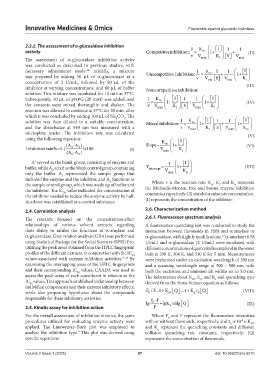
2.3.2. The assessment of α-glucosidase inhibition 1 K I 1 1
activity Competitiveinhibition: = m 1+ + (II)
S
v V max K i V
The assessment of α-glucosidase inhibition activity maax
was conducted as described in previous studies, with
necessary adjustments made. Initially, a mixture 1 K m 1 1 [ ] I
14
was prepared by adding 50 μL of α-glucosidase at a Uncompetitive inhibition: = V [ ] S + V max 1+ K i
v
concentration of 2 U/mL, followed by 50 μL of the max
inhibitor at varying concentrations, and 80 μL of buffer Noncompetitive inhibition: (III)
solution. This mixture was incubated for 10 min at 37°C.
I
I
Subsequently, 50 μL of pNPG (20 mM) was added, and 1 = K m 1+ 1 + 1 1 1+ (IV)
the contents were mixed thoroughly and shaken. The v V max K S V max K
i
i
reaction was allowed to continue at 37°C for 20 min, after
which it was concluded by adding 100 μL of Na CO . The
I
I
3
2
1
solution was then diluted to a suitable concentration, Mixedinhibition: = K m 1+ 1 + 1 1+
S
and the absorbance at 540 nm was measured with a v V max K i V max K is
microplate reader. The inhibition rate was calculated (V)
using the following equation: K I
(A -A ) Slope= m 1+ (VI)
Inhibitionrate%=1-[ 3 4 ] 100 (I) V max K
×
i
(A -A )
2
1
A served as the blank group, consisting of enzyme and 1
I
1
buffer, while A acted as the blank control group, containing Y intercept = V 1+ K (VII)
2
only the buffer. A represented the sample group that max is
3
included the enzyme and the inhibitor, and A functions as
4
the sample control group, which was made up of buffer and Where v is the reaction rate; K , K, and K represent
m
is
i
the inhibitor. The IC value indicated the concentration of the Michaelis-Menten, free and bound enzyme inhibition
50
the inhibitor needed to reduce the enzyme activity by half. constants, respectively; [S] stands for substrate concentration;
Acarbose was established as a control substance. [I] represents the concentration of the inhibitor.
2.4. Correlation analysis 2.6. Characterization method
The research focused on the concentration-effect 2.6.1. Fluorescence spectrum analysis
relationships of various solvent extracts regarding A fluorescence quenching test was conducted to study the
their ability to inhibit the functions of α-amylase and interaction between flavonoids in FBSJ and α-amylase or
α-glucosidase. Grey relation analysis (GRA) was performed α-glucosidase, with slightly modifications. α-amylase (0.58
17
using Statistical Package for the Social Sciences (SPSS) Pro, U/mL) and α-glucosidase (2 U/mL) were incubated with
utilizing the peak areas obtained from the HPLC fingerprint different concentrations of quercetin/kaempferol in the water
profiles of the different extracts, in conjunction with the IC bath at 298 K, 304 K, and 310 K for 5 min. Measurements
50
values associated with enzyme inhibition activities. 15,16 By were performed under an excitation wavelength of 280 nm
examining the overlapping areas of the HPLC fingerprints and a scanning wavelength range of 300 – 500 nm, with
and their corresponding IC values, CAADA was used to both the excitation and emission slit widths set to 5.0 nm.
50
assess the peak areas of each constituent in relation to the The information about K , K , and K and quenching type
SV
q
a
IC values. This approach established a relationship between derived from the Stern-Volmer equation as follows:
50
individual components and their enzyme inhibitory effects,
1
q 0
sv
while also proposing hypotheses about the compounds FF 1/ K Q K Q (VIII)
0
responsible for these inhibitory activities. F-F
lg 0 =lgK +nlg Q (IX)
a
2.5. Kinetic assay for inhibition action F
For the overall assessment of inhibition kinetics, the same Where F and F represent the fluorescence intensities
0
procedures utilized for evaluating enzyme activity were with or without flavonoids, respectively, and τ is 10 s; K ,
-8
0
SV
applied. The Lineweaver–Burk plot was employed to and K represent the quenching constants and diffusion
q
analyze the inhibition type. This plot was derived using collision quenching rate constants, respectively; [Q]
8
specific equations: represents the concentration of flavonoids.
Volume 2 Issue 1 (2025) 57 doi: 10.36922/imo.6010

