


Page 67 - IMO-2-1
P. 67
Innovative Medicines & Omics                                         Flavonoids against glycosidic hydrolase


                         A                                  B


                         C                                  D


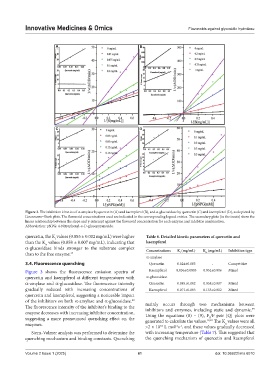
            Figure 2. The inhibition kinetics of α-amylase by quercetin (A) and kaempferol (B), and α-glucosidase by quercetin (C) and kaempferol (D), as depicted by
            Lineweaver–Burk plots. The flavonoid concentrations used are indicated in the corresponding legend entries. The secondary plots (in the insets) show the
            linear relationship between the slope and y-intercept against the flavonoid concentration for each enzyme and inhibitor combination.
            Abbreviation: pNPG: 4-Nitrophenyl-α-D-glucopyranoside.

            quercetin, the K values (0.085 ± 0.002 mg/mL) were higher   Table 6. Detailed kinetic parameters of quercetin and
                        i
            than the K  values (0.058 ± 0.007 mg/mL), indicating that   kaempferol
                    is
            α-glucosidase binds stronger to the substrate complex   Concentrations  K  (mg/mL)  K  (mg/mL)  Inhibition type
            than to the free enzyme. 37                                       i         is
                                                               α-amylase
            3.4. Fluorescence quenching                         Quercetin   0.024±0.003    -      Competitive
            Figure  3 shows the fluorescence emission spectra of   Kaempferol  0.036±0.0003  0.051±0.006  Mixed
            quercetin and kaempferol at different temperatures with   α-glucosidase
            α-amylase and α-glucosidase. The fluorescence intensity   Quercetin  0.085±0.002  0.058±0.007  Mixed
            gradually reduced with increasing concentrations of   Kaempferol  0.071±0.003  0.155±0.012  Mixed
            quercetin and kaempferol, suggesting a noticeable impact
            of the inhibitors on both α-amylase and α-glucosidase.
                                                         38
            The fluorescence intensity of the inhibitor’s binding to the   mainly occurs through two mechanisms between
                                                               inhibitors and enzymes, including static and dynamic.
                                                                                                            39
            enzyme decreases with increasing inhibitor concentration,   Using the equations (8) – (9), F /F pair [Q] plots were
            suggesting a more pronounced quenching effect on the   generated to calculate the values. 12,40  The K  values were all
                                                                                          0
                                                                                                 q
            enzymes.                                           >2 × 10  L mol s , and these values gradually decreased
                                                                            -1 -1
                                                                     10
              Stern-Volmer analysis was performed to determine the   with increasing temperature (Table 7). This suggested that
            quenching mechanism and binding constants. Quenching   the quenching mechanism of quercetin and kaempferol
            Volume 2 Issue 1 (2025)                         61                               doi: 10.36922/imo.6010

