


Page 70 - IMO-2-1
P. 70
Innovative Medicines & Omics                                         Flavonoids against glycosidic hydrolase


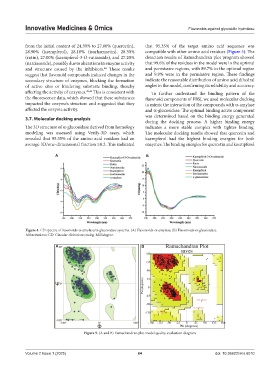
            from the initial content of 24.30% to 27.00% (quercetin),   that 95.35% of the target amino acid sequence was
            28.90% (kaempferol), 28.10% (isorhamnetin), 28.30%   compatible with other amino acid residues (Figure 5). The
            (rutin), 27.00% (kaempferol-3-O-rutinoside), and 27.20%   detection results of Ramachandran plot program showed
            (narcissoside), possibly due to alterations in enzyme activity   that 99.6% of the residues in the model were in the optimal
            and structure caused by the inhibitors.  These results   and permissive regions, with 89.7% in the optimal region
                                             44
            suggest that flavonoid compounds induced changes in the   and 9.9% were in the permissive region. These findings
            secondary structure of enzymes, blocking the formation   indicate the reasonable distribution of amino acid dihedral
            of active sites or hindering substrate binding, thereby   angles in the model, confirming its reliability and accuracy.
            affecting the activity of enzymes. 45,46  This is consistent with   To further understand the binding pattern of the
            the fluorescence data, which showed that these substances   flavonoid components of FBSJ, we used molecular docking
            impacted the enzyme’s structure and suggested that they   to mimic the interaction of the compounds with α-amylase
            affected the enzyme activity.                      and α-glucosidase. The optimal binding active component
                                                               was  determined  based  on  the  binding  energy  generated
            3.7. Molecular docking analysis
                                                               during the docking process. A  higher binding energy
            The 3D structure of α-glucosidase derived from homology   indicates  a  more  stable  complex  with  tighter  binding.
            modeling was assessed using Verify-3D assay, which   The molecular docking results showed that quercetin and
            revealed  that  95.35%  of  the  amino  acid  residues  had  an   kaempferol had the highest binding energies for both
            average 3D/one-dimensional fraction ≥0.2. This indicated   enzymes. The binding energies for quercetin and kaempferol

                         A                                     B


            Figure 4. CD spectra of flavonoids-α-amylase/α-glucosidase systems. (A) Flavonoids-α-amylase; (B) Flavonoids-α-glucosidase.
            Abbreviations: CD: Circular dichroism; mdeg: Millidegree.

                         A                                   B


                                     Figure 5. (A and B) Ramachandran plot model quality evaluation diagram


            Volume 2 Issue 1 (2025)                         64                               doi: 10.36922/imo.6010

