


Page 73 - IMO-2-1
P. 73
Innovative Medicines & Omics                                         Flavonoids against glycosidic hydrolase


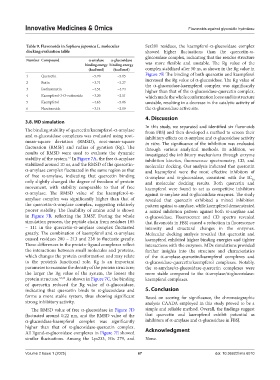
            Table 9. Flavonoids in Sophora japonica L. molecular   Ser281 residues, the kaempferol-α-glucosidase complex
            docking evaluation table                           showed higher fluctuations than the quercetin-α-
                                                               glucosidase complex, indicating that the residue structure
            Number Compound            α-amylase   α-glucosidase
                                     binding energy  binding energy   was more flexible and unstable. The Rg value of the
                                       (kcal/mol)  (kcal/mol)  complex stabilized after 50 ns, as shown in the Rg value in
            1      Quercetin            −5.70      −5.15       Figure 7F. The binding of both quercetin and kaempferol
            2      Rutin                −3.71      −3.27       increased the Rg value of α-glucosidase. The Rg value of
                                                               the  α-glucosidase-kaempferol complex was significantly
            3      Isorhamnetin         −4.54      −4.74       higher than that of the α-glucosidase-quercetin complex,
            4      Kaempferol-3-O-rutinoside  −3.20  −2.51     which made the whole conformation loose and its structure
            5      Kaempferol           −4.63      −5.06       unstable, resulting in a decrease in the catalytic activity of
            6      Narcissoside         −3.14      −2.19       the α-glucosidase active site.
                                                               4. Discussion
            3.8. MD simulation
                                                               In  this  study, we  separated and  identified six  flavonoids
            The binding stability of quercetin/kaempferol-α-amylase   from FBSJ and then developed a method to screen their
            and α-glucosidase complexes was evaluated using root-  inhibitory effects on α-amylase and α-glucosidase activity
            mean-square  deviation  (RMSD),  root-mean-square   in vitro. The significance of the inhibition was evaluated
            fluctuation (RMSF) and radius of gyration (Rg). The   through various analytical methods. In addition, we
            results of RMSD were used to evaluate the dynamic   investigated the inhibitory mechanisms through enzyme
            stability of the system.  In Figure 7A, the free α-amylase   inhibition kinetics, fluorescence spectrometry, CD, and
                              51
            stabilized around 10 ns, and the RMSD of the quercetin-  molecular docking. Our analysis indicated that quercetin
            α-amylase complex fluctuated in the same region as that   and kaempferol were the most effective inhibitors of
            of free  α-amylase, indicating that quercetin binding   α-amylase and  α-glucosidase, consistent with the IC
                                                                                                            50
            only slightly changed the degree of freedom of protein   and molecular docking results. Both quercetin and
            movement,  with  stability  comparable  to  that  of  free   kaempferol were found to act as competitive inhibitors
            α-amylase. The RMSD value of the kaempferol-α-     against α-amylase and α-glucosidase enzymes. The study
            amylase  complex  was  significantly  higher  than  that  of   revealed that quercetin exhibited a mixed inhibition
            the quercetin-α-amylase complex, suggesting relatively   pattern against α-amylase, while kaempferol demonstrated
            poorer stability. The flexibility of amino acid is shown   a  mixed  inhibition  pattern  against  both  α-amylase  and
            in  Figure  7B,  reflecting the  RMSF.  During  the  whole   α-glucosidase. Fluorescence and CD spectra revealed
            simulation process, the peptide chain from residues 105   that flavonoids in FBSJ caused a reduction in fluorescence
            – 111 in the quercetin-α-amylase complex fluctuated   intensity and structural changes in the enzymes.
            greatly. The combination of kaempferol and α-amylase   Molecular docking analysis revealed that quercetin and
            caused residues 200 – 213 and 238 to fluctuate greatly.   kaempferol exhibited higher binding energies and tighter
            These differences in the protein-ligand complexes reflect   interactions with the enzymes. MDs simulations provided
            the interactions between small molecules and proteins,   further insights into the structure and characteristics
            which changes the protein conformation and may relate   of the  α-amylase-quercetin/kaempferol complexes and
            to the protein’s functional role. Rg is an important   α-glucosidase-quercetin/kaempferol complexes. Notably,
            parameter to examine the density of the protein structure;   the  α-amylase/α-glucosidase-quercetin complexes were
            the larger the Rg value of the system, the looser the   more stable compared to the  α-amylase/α-glucosidase-
            protein structure. 52,53  As shown in Figure 7C, the binding   kaempferol complexes.
            of quercetin reduced the Rg value of  α-glucosidase,
            indicating that quercetin binds to  α-glucosidase and   5. Conclusion
            forms a more stable system, thus showing significant   Based on scoring for significance, the chromatographic
            strong inhibitory activity.                        analysis CAADA employed in this study proved to be a

              The  RMSD value  of  free  α-glucosidase  in  Figure  7D   simple and reliable method. Overall, the findings suggest
            fluctuated around 0.22  nm, and the RMSD value of the   that  quercetin  and kaempferol  exhibit  potential  as
            α-glucosidase-kaempferol complex was significantly   inhibitors of α-amylase and α-glucosidase in FBSJ.
            higher than that of  α-glucosidase-quercetin complex.
            All ligand-α-glucosidase complexes in Figure 7E showed   Acknowledgment
            similar fluctuations. Among the Lys233, His 279, and   None.


            Volume 2 Issue 1 (2025)                         67                               doi: 10.36922/imo.6010

