


Page 72 - IMO-2-1
P. 72
Innovative Medicines & Omics                                         Flavonoids against glycosidic hydrolase


                         A                                   B


                         C                                   D


                         E
                                                              F


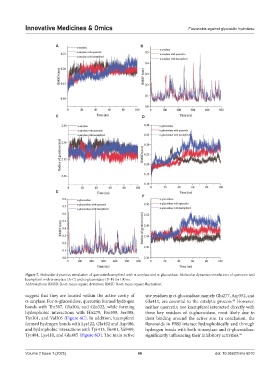
            Figure 7. Molecular dynamics simulation of quercetin/kaempferol with α-amylase and α-glucosidase. Molecular dynamics simulations of quercetin and
            kaempferol with α-amylase (A-C) and α-glucosidase (D-F) for 100 ns.
            Abbreviations: RMSD: Root-mean-square deviation; RMSF: Root-mean-square fluctuation.

            suggest that they are located within the active cavity of   site residues in α-glucosidase, namely Glu277, Asp352, and
            α-amylase. For α-glucosidase, quercetin formed hydrogen   Glu411, are essential to the catalytic process.  However,
                                                                                                    49
            bonds with Thr307, Glu304, and Gln322, while forming   neither quercetin nor kaempferol interacted directly with
            hydrophobic interactions with His279, Pro309, Ser308,   these key residues of  α-glucosidase, most likely due to
            Thr301, and Val305 (Figure 6C). In addition, kaempferol   their binding around the active site. In conclusion, the
            formed hydrogen bonds with Lys422, Glu402 and Asp406,   flavonoids in FBSJ interact hydrophobically and through
            and hydrophobic interactions with Tyr413, Ile401, Val409,   hydrogen bonds with both α-amylase and α-glucosidase,
            Tyr404, Lys410, and Glu405 (Figure 6D). The main active   significantly influencing their inhibitory activities. 50


            Volume 2 Issue 1 (2025)                         66                               doi: 10.36922/imo.6010

