


Page 71 - IMO-2-1
P. 71
Innovative Medicines & Omics                                         Flavonoids against glycosidic hydrolase


                         A


                         B


                         C


                         D


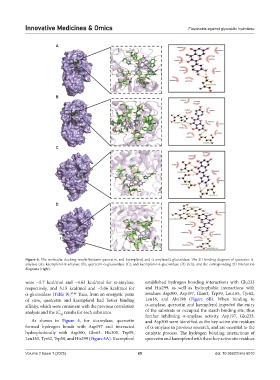
            Figure 6. The molecular docking results between quercetin, and kaempferol, and α-amylase/α-glucosidase. The 3D binding diagram of quercetin-α-
            amylase (A), kaempferol-α-amylase (B), quercetin-α-glucosidase (C), and kaempferol-α-glucosidase (D) (left), and the corresponding 2D interaction
            diagrams (right).

            were −5.7 kcal/mol and −4.63 kcal/mol for  α-amylase,   established hydrogen bonding interactions with Glu233
            respectively, and 5.15 kcal/mol and −5.06 kcal/mol for   and His299, as well as hydrophobic interactions with
            α-glucosidase (Table 9). 47,48  Thus, from an energetic point   residues Asp300, Asp197, Gln63, Trp59, Leu165, Tyr62,
            of view, quercetin and kaempferol had better binding   Leu16, and Aln198 (Figure  6B). When binding to
            affinity, which were consistent with the previous correlation   α-amylase, quercetin and kaempferol impeded the entry
            analysis and the IC  results for each substance.   of the substrate or occupied the starch binding site, thus
                           50
                                                               further inhibiting  α-amylase activity. Asp197, Glu233,
              As shown in  Figure  6, for  α-amylase, quercetin   and Asp300 were identified as the key active site residues
            formed hydrogen bonds with Asp197 and interacted   of α-amylase in previous research, and are essential to the
            hydrophobically with Asp300, Gln63, His305, Trp59,   catalytic process. The hydrogen bonding interactions of
            Leu165, Tyr62, Trp58, and His299 (Figure 6A). Kaempferol   quercetin and kaempferol with these key active site residues


            Volume 2 Issue 1 (2025)                         65                               doi: 10.36922/imo.6010

