


Page 27 - IMO-2-2
P. 27
Innovative Medicines & Omics                                           Herbal remedies for diabetes mellitus


            abnormalities and an increased susceptibility to infections.
                                                          3
            Over time, diabetes can lead to severe complications, such
            as diabetic nephropathy, neuropathy, retinopathy, obesity,
            and cardiovascular disease, resulting in progressive damage
            to the eyes, kidneys, heart, and nervous system.  Diabetes
                                                  1
            is currently classified according to its pathophysiological
            mechanisms and underlying etiology, which guide clinical
            assessment and treatment choice. The four main types of
            DM include type  1 DM (T1DM), type  2 DM (T2DM),
            gestational DM (GDM), and maturity-onset diabetes of
            the young (MODY). 4
              Globally, the burden of diabetes is escalating at
            an  alarming  rate.  In  2021,  approximately  537  million
            adults aged 20 – 79 years were diagnosed with diabetes,
            accounting for 10.5% of the world’s population. This
            number is projected to rise to 643 million by 2030 and
            783 million by 2045. In addition, 541 million individuals
            exhibited impaired glucose tolerance, placing them at
            heightened risk of developing diabetes. The rising trend
            of  youth-onset  T2DM  is  particularly  concerning,  as  it
            leads to an earlier onset of complications and a prolonged
            lifetime  disease  burden.  A  major  challenge  in  diabetes
            management is the high prevalence of undiagnosed
            cases, particularly in low- and middle-income countries,
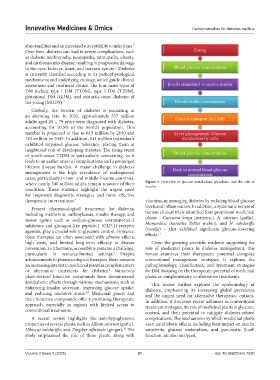
            where nearly 240 million adults remain unaware of their   Figure  1.  Overview of glucose metabolism, glycolysis, and the role of
                                                               insulin
            condition. These statistics highlight the urgent need
            for improved diagnostic strategies and more effective
            therapeutic interventions. 5                       vitamins, in managing diabetes by reducing blood glucose

              Present pharmacological treatments for diabetes,   levels and inflammation. In addition, a systematic review of
            including metformin, sulfonylureas, insulin therapy, and   human clinical trials identified four prominent medicinal
            newer agents such as sodium-glucose cotransporter-2   plants –  Curcuma longa (turmeric),  A. sativum (garlic),
            inhibitors and glucagon-like peptide-1 (GLP-1) receptor   Momordica charantia (bitter melon), and  H. sabdariffa
            agonists, play a crucial role in glycemic control. However,   (roselle) – that exhibited significant glucose-lowering
                                                                    11
            these therapies are often associated with adverse effects,   effects.
            high costs, and limited long-term efficacy in disease   Given the growing scientific evidence supporting the
            prevention. Furthermore, accessibility remains a challenge,   role of medicinal plants in diabetes management, this
            particularly in resource-limited settings.  Despite   review examines their therapeutic potential alongside
                                                 6
            advancements in pharmacological therapies, there remains   conventional  management  strategies.  It  explores  the
            an increasing interest in medicinal plants as complementary   pathophysiology, classification, and treatment strategies
            or alternative treatments for diabetes.  Numerous   for DM, focusing on the therapeutic potential of medicinal
                                               7
            plant-derived bioactive compounds have demonstrated   plants as complementary or alternative treatments.
            antidiabetic effects through various mechanisms, such as   This review further explores the epidemiology of
            enhancing  insulin  secretion,  improving  glucose  uptake,   diabetes, emphasizing its increasing global prevalence
            and  reducing  oxidative  stress.   Medicinal  plants  and   and  the  urgent  need  for  alternative  therapeutic  options.
                                     8,9
            their bioactive compounds offer a promising therapeutic   In addition, it discusses recent advances in conventional
            approach, especially in regions with limited access to   treatment strategies, the role of medicinal plants in glycemic
            conventional treatments.                           control, and their potential to mitigate diabetes-related
              A  recent  review  highlights  the  anti-hypoglycemic   complications. The mechanisms by which medicinal plants
            properties of several plants, such as Allium sativum (garlic),   exert antidiabetic effects, including their impact on insulin
            Hibiscus sabdariffa, and Zingiber officinale (ginger).  The   sensitivity, glucose metabolism, and pancreatic  β-cell
                                                     10
            study emphasized the role of these plants, along with   function, are also analyzed.


            Volume 2 Issue 2 (2025)                         21                               doi: 10.36922/imo.7520

