


Page 32 - IMO-2-2
P. 32
Innovative Medicines & Omics                                           Herbal remedies for diabetes mellitus


            services. It plays a crucial role in diabetes education   induced pluripotent stem cells, embryonic stem cells, and
            and management. 41,42  The optimization of MNT for   adult stem cells. 45,46
            DM remains an area of ongoing research, particularly
            concerning energy content, macronutrient distribution,   5.3. Oral hypoglycemic agents
            and quantity.  While MNT aims to develop diet plans that   Oral hypoglycemic agents are widely used in the treatment
                      42
            are  both  evidence-based  and  patient-centered,  concerns   of T2DM. These agents include biguanides, sulfonylureas,
            have been raised regarding its ability to balance medical   meglitinides, thiazolidinediones, dipeptidyl peptidase
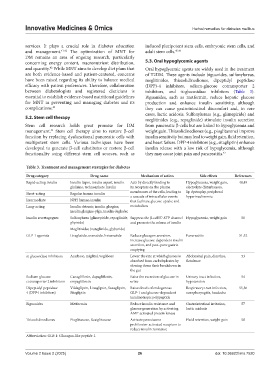
            efficacy with patient preferences. Therefore, collaboration   (DPP)-4 inhibitors, odium-glucose cotransporter 2
            between  diabetologists  and  registered  dieticians  is   inhibitors, and  α-glucosidase inhibitors (Table  3).
            essential to establish evidence-based nutritional guidelines   Biguanides, such as metformin, reduce hepatic glucose
            for MNT in preventing and managing diabetes and its   production and enhance insulin sensitivity, although
            complications. 43                                  they can cause gastrointestinal discomfort and, in rare
                                                               cases, lactic acidosis. Sulfonylureas (e.g., glimepiride) and
            5.2. Stem cell therapy                             meglitinides (e.g., repaglinide) stimulate insulin secretion
            Stem cell research holds great promise for DM      from pancreatic β-cells but are linked to hypoglycemia and
            management.  Stem cell therapy aims to restore  β-cell   weight gain. Thiazolidinediones (e.g., pioglitazone) improve
                       44
            function by replacing dysfunctional pancreatic cells with   insulin sensitivity but may lead to weight gain, fluid retention,
            multipotent stem cells. Various techniques have been   and heart failure. DPP-4 inhibitors (e.g., sitagliptin) enhance
            developed to generate β-cell substitutes or restore β-cell   insulin release with a low risk of hypoglycemia, although
            functionality using different stem cell sources, such as   they may cause joint pain and pancreatitis. 47


            Table 3. Treatment and management strategies for diabetes
            Drug category              Drug name             Mechanism of action      Side effects   References
            Rapid-acting insulin  Insulin lispro, insulin aspart, insulin   Acts by directly binding to   Hypoglycemia, weight gain,   48,49
                               glulisine, technosphere Insulin  its receptors on the plasma   electrolyte disturbances,
            Short-acting       Regular human insulin    membranes of the cells, leading to   lip dystrophy, peripheral
                                                        a cascade of intracellular events   hyperinsulinemia
            Intermediate       NPH human insulin        that facilitate glucose uptake and
            Long-acting        Insulin detemir, insulin glargine,   metabolism
                               insulin glargine-yfgn, insulin degludec
            Insulin secretagogues  Sulfonylurea (glimepiride, repaglinide,  Suppress the β-cell K ATP channel  Hypoglycemia, weight gain  50
                                                                      +
                               glipizide)               and promote the release of insulin
                               Meglitinides (nateglinide, glyburide)
            GLP-1 agonists     Liraglutide, exenatide, lixisenatide  Reduce glucagon secretion,   Pancreatitis  51,52
                                                        increase glucose-dependent insulin
                                                        secretion, and post-pone gastric
                                                        emptying
            α-glucosidase inhibitors  Acarbose, miglitol, voglibose  Lower the rate at which glucose is   Abdominal pain, diarrhea,   53
                                                        absorbed from carbohydrates by   flatulence
                                                        slowing down their breakdown in
                                                        the gut
            Sodium-glucose     Canagliflozin, dapagliflozin,   Raise the excretion of glucose in   Urinary tract infection,   54
            cotransporter 2 inhibitors  empagliflozin   urine                   hypotension
            Dipeptidyl peptidase    Vildagliptin, Linagliptin, Saxagliptin,  Raises levels of endogenous   Respiratory tract infection,   55,56
            4 (DPP4 inhibitors)  Sitagliptin            GLP-1 and glucose-dependent   nasopharyngitis, headache
                                                        insulinotropic polypeptide
            Biguanides         Metformin                Reduce insulin resistance and   Gastrointestinal irritation,   57
                                                        glucose generation by activating   lactic acidosis
                                                        AMP-activated protein kinase
            Thiazolidinediones  Pioglitazone, Rosiglitazone  Activate peroxisome   Fluid retention, weight gain  58
                                                        proliferator-activated receptors to
                                                        reduce insulin resistance
            Abbreviation: GLP-1: Glucagon-like peptide 1.


            Volume 2 Issue 2 (2025)                         26                               doi: 10.36922/imo.7520

