


Page 10 - IMO-2-3
P. 10
Innovative Medicines & Omics                              MSC exosomes for digestive tumors: Bench to bedside


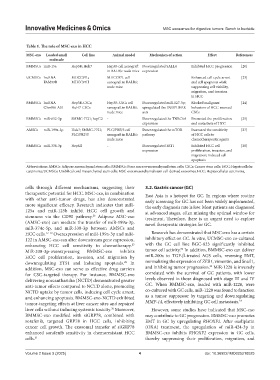
            Table 1. The role of MSC‑exo in HCC
            MSC‑exo   Loaded small   Cell line   Animal model    Mechanism of action     Effect      References
                      molecule
            BMMSCs miR-15a     Hep3B; Huh7     Hep3B cell xenograft  Downregulated SALL4   Inhibited HCC progression  [20]
                                               in BALB/c nude mice expression
            UCMSCs lncRNA      MHCC97L;        MHCC97L cell   -                   Enhanced cell cycle arrest   [23]
                    FAM99B     MHCC97H         xenograft in BALB/c                and cell apoptosis while
                                               nude mice                          suppressing cell viability,
                                                                                  migration, and invasion
                                                                                  in HCC
            BMMSCs lncRNA      Hep3B-CSCs;     Hep3B-CSCs cell   Downregulated miR-127-3p;   Blocked malignant   [24]
                    C5orf66-AS1  HuH7-CSCs     xenograft in BALB/c  upregulated the DUSP1/ERK   behaviors of HCC-sourced
                                               nude mice      axis                CSCs
            BMMSCs miR-652-3p  SMMC-7721; hepG2  -            Downregulated the TNRC6A   Promoted the proliferation   [25]
                                                              expression          and metastasis of HCC
            AMSCs   miR-199a-3p  Huh7; SMMC-7721;   PLC/PRF/5 cell   Downregulated the mTOR   Increased the sensitivity   [27]
                               PLC/PRF/5       xenograft in BALB/c  pathway       of HCC cells to
                                               nude mice                          chemotherapeutic agents
            BMMSCs miR-338-3p  HepG2           -              Downregulated EST1   Inhibited HCC cell   [28]
                                                              expression          proliferation, invasion, and
                                                                                  migration; induced cell
                                                                                  apoptosis
            Abbreviations: AMSCs: Adipose mesenchymal stem cells; BMMSCs: Bone marrow mesenchymal stem cells; CSCs: Cancer stem cells; HCC: Hepatocellular
            carcinoma; UCMSCs: Umbilical cord mesenchymal stem cells; MSC-exo: mesenchymal stem cell-derived exosomes; HCC: Hepatocellular carcinoma.


            cells through different mechanisms, suggesting their   3.2. Gastric cancer (GC)
            therapeutic potential for HCC. MSC-exo, in combination   East Asia is a hotspot for GC. In regions where routine
            with other anti-tumor drugs, has also demonstrated   early screening for GC has not been widely implemented,
            more significant efficacy. Research indicates that miR-  the early diagnosis rate is low. Most patients are diagnosed
            125a and miR-125b inhibit HCC cell growth and      at advanced stages, often missing the optimal window for
                                        26
            stemness via the CD90 pathway.  Adipose MSC-exo    treatment. Therefore, there is an urgent need to explore
            (AMSC-exo) can mediate the transfer of miR-199a-3p,   novel therapeutic strategies for GC.
            miR-374c-5p,  and  miR-338-3p  between  AMSCs  and
            HCC cells. 27-29  Overexpression of miR-199a-3p and miR-  Research has demonstrated that MSC-exo has a certain
            122 in AMSC-exo can alter downstream gene expression,   inhibitory effect on GC. In vitro, UCMSC-exo co-cultured
            enhancing HCC cell sensitivity to chemotherapy.    with the GC cell line BGC-823 significantly inhibited
                                                         27
                                                                              32
            MiR-338-3p-overexpressing  BMMSC-exo    inhibits   tumor cell activity.  In addition, BMMSC-exo can deliver
            HCC cell proliferation, invasion, and migration by   miR-200a to TGF-β-treated AGS cells, reversing EMT,
            downregulating ETS1 and inducing apoptosis.  In    normalizing the expression of ZEB1, vimentin, and Snail1,
                                                      28
                                                                                          33
            addition, MSC-exo can serve as effective drug carriers   and inhibiting tumor progression.  MiR-1228 is inversely
            for CSC-targeted therapy. For instance, BMMSC-exo   correlated with the  survival  of  GC patients,  with  lower
            delivering norcantharidin (NCTD) demonstrated greater   levels observed in those diagnosed with stage III and IV
            anti-tumor effects compared to NCTD alone, promoting   GC. When BMMSC-exo, loaded with miR-1228, were
            NCTD uptake by tumor cells, inducing cell cycle arrest,   co-cultured with GC cells, miR-1228 was found to function
            and enhancing apoptosis. BMMSC-exo-NCTD exhibited   as a tumor suppressor by targeting and downregulating
            tumor-targeting effects at liver cancer sites and repaired   MMP-14, effectively inhibiting GC cell metastasis. 34
            liver cells without inducing systemic toxicity.  Moreover,   However, some studies have indicated that MSC-exo
                                                30
            BMMSC-exo modified with siGRP78, combined with     may contribute to GC progression. BMMSC-exo promotes
            sorafenib, targeted GRP78 in HCC cells, inhibiting   EMT in GC by upregulating  RHOXF2. After oxaliplatin
            cancer cell growth. The exosomal transfer of siGRP78   (OXA) treatment, the upregulation of miR-424-3p in
            enhanced sorafenib sensitivity in chemoresistant HCC   BMMSC-exo inhibits  RHOXF2 expression in GC cells,
            cells. 31                                          thereby suppressing their proliferation, migration, and


            Volume 2 Issue 3 (2025)                         4                           doi: 10.36922/IMO025210025

