


Page 11 - IMO-2-3
P. 11
Innovative Medicines & Omics                              MSC exosomes for digestive tumors: Bench to bedside


            invasion. This suggests that delivering miR-424-3p   expression of aquaporin 5 (AQP5) and EGFR genes, which
            through BMMSC-exo is a promising therapeutic approach   are key molecules in tumor progression, within the HCT-
            for GC.  In addition, MSC-exo conferred drug resistance   116 tumor cell line.  BMMSC-exo can also deliver miR-
                                                                               41
                  35
            to GC cells, primarily through their protein content.   100 into CRC cells, downregulating the mTOR/miR-143
            These proteins activate the  CaM-Ks/Raf/MEK/ERK    axis and inhibiting CRC cell proliferation, migration, and
            signaling pathway, increase multidrug resistance protein   invasion.  In addition, BMMSC-exo can inhibit tumor-
                                                                      42
            expression, and protect GC cells from chemotherapy-  associated macrophage activity. Research has demonstrated
            induced apoptosis.  Another study found that exosomes   that UCMSC-exo mediates miR-1827, inhibiting SUCNR1
                           36
            from p53-deficient BMMSCs enhance the proliferation   in CRC cells. Furthermore, UCMSC-exo also suppresses
            and migration of GC cells and p53 wild-type BMMSCs.    M2 macrophage polarization and liver metastasis. 43
                                                         37
            Research has also reported that BMMSC-exo can transfer   Studies have confirmed that MSC-exo significantly
            miR-374a-5p to GC cells, enhancing the expression of   inhibits overexpressed integrin family proteins in CRC
            adhesion molecules in these cells by targeting HAPLN1,         44
            which in turn facilitates the migration of GC cells.    cells.  Xu  et al. demonstrated that  integrin  α2 (ITGA2)
                                                         38
            BMMSC-exo has been proposed to secrete miR-221,    is overexpressed in CRC cells. It is indicated that miR-
            which acts as a tumor-promoting molecule by activating   16-5p derived from BMMSC-exo inhibits CRC cells by
                                                                                  44
            the Hedgehog and PTEN/P27 signaling pathways, thereby   downregulating ITGA2.  Some studies have reported that
            promoting GC proliferation and progression.  Moreover,   MSC-exo may promote CRC. AMSC-exo promotes the
                                                39
            BMMSC-exo can promote tumor growth by triggering the   advancement of CRC by triggering the transformation
            Hedgehog signaling pathway  (Table 2).             of MSCs into CAFs (MSC-CAFs) via the TRPC3/NF-KB
                                   40
                                                               signaling pathway (Table 3).
                                                                             45
            3.3. Colorectal cancer (CRC)                         In recent years, MSC-exo-based therapies have become
            For advanced-stage CRC, enhancing the efficacy of drug   a key focus of research for treating CRC. Studies have
            therapy is crucial. Most studies suggest that MSC-exo can   reported that UCMSC-exo upregulates miR-431-5p,
            inhibit CRC. AMSC-exo has been reported to suppress the   consequently inhibiting CRC progression by suppressing

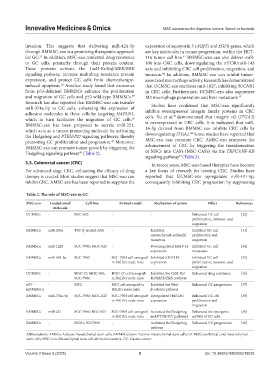
            Table 2. The role of MSC‑exo in GC
            MSC‑exo   Loaded small   Cell line      Animal model   Mechanism of action    Effect     References
                        molecule
            UCMSCs    -          BGC-823         -               -                 Enhanced GC cell     [32]
                                                                                   proliferation, invasion, and
                                                                                   migration
            BMMSCs    miR-200a   TGF-β-treated AGS  -            Inhibited         Inhibited GC cell    [33]
                                                                 mesenchymal-epithelial   proliferation and
                                                                 transition        migration
            BMMSCs    miR-1228   SGC-7901; MGC-823  -            Downregulated MMP-14  Inhibited GC cell   [34]
                                                                 expression        metastasis
            BMMSCs    miR-424-3p  SGC-7901       SGC-7901 cell xenograft  Inhibited RHOXF2   Inhibited GC cell   [35]
                                                 in BALB/c nude mice  expression   proliferation, invasion, and
                                                                                   migration
            UCMSCs    -          HGC-27; MGC-803;   HGC-27 cell xenograft   Inhibited the CaM-Ks/  Enhanced drug resistance  [36]
                                 SGC-7901        in BALB/c nude mice  Raf/MEK/ERK pathway
            p53 –/–   -          MFC             MFC cell xenograft in   Inhibited the Wnt/  Enhanced GC progression  [37]
            mBMMSCs                              BALB/c nude mice  β-catenin pathway
            BMMSCs    miR-374a-5p  SGC-7901; MGC-823  SGC-7901 cell xenograft  Upregulated HAPLN1   Enhanced GC cell   [38]
                                                 in BALB/c nude mice  expression   proliferation and
                                                                                   migration
            BMMSCs    miR-221    SGC-7901; BGC-823  SGC-7901 cell xenograft  Activated the Hedgehog   Enhanced the oncogenic   [39]
                                                 in BALB/c nude mice  and PTEN/P27 pathways  activity of GC cells
            BMMSCs    -          MG63; SGC7901   -               Activated the Hedgehog   Enhanced GC progression  [40]
                                                                 pathway
            Abbreviations: AMSCs: Adipose mesenchymal stem cells; BMMSCs: bone marrow mesenchymal stem cells; UCMSCs: umbilical cord mesenchymal
            stem cells; MSC-exo: Mesenchymal stem cell-derived exosomes; GC: Gastric cancer.


            Volume 2 Issue 3 (2025)                         5                           doi: 10.36922/IMO025210025

