


Page 13 - IMO-2-3
P. 13
Innovative Medicines & Omics                              MSC exosomes for digestive tumors: Bench to bedside


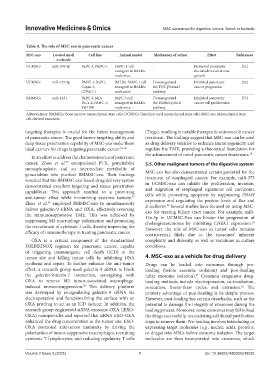
            Table 4. The role of MSC‑exo in pancreatic cancer
            MSC‑exo     Loaded small   Cell line    Animal model   Mechanism of action   Effect       References
                         molecule
            UCMSCs     miR-100-5p   BxPC-3; PANC-1  PANC-1 cell   -                 Promoted pancreatic   [51]
                                                  xenograft in BALB/c               ductal adenocarcinoma
                                                  nude mice                         growth
            UCMSCs     miR-145-5p   PANC-1; BxPC;   BALB/c PANC-1 cell   Downregulated   Inhibited pancreatic   [52]
                                    Capan-1;      xenograft in BALB/c   the TGF-β/Smad3   cancer progression
                                    CFPAC-1       nude mice       pathway
            BMMSCs     miR‐1231     BxPC‐3; MIA   BxPC‐3 cell     Downregulated     Inhibited pancreatic   [53]
                                    PaCa‐2; PANC‐1;   xenograft in BALB/c   the EGFR/cyclin E   cancer cell proliferation
                                    SW1990        nude mice       pathway
            Abbreviations: BMMSCs: Bone marrow mesenchymal stem cells; UCMSCs: Umbilical cord mesenchymal stem cells; MSC-exo: Mesenchymal stem
            cell-derived exosomes.

            targeting therapies is crucial for the future management   (Tregs), resulting in notable therapeutic outcomes in cancer
            of pancreatic cancer. The good tumor-targeting ability and   treatment. The findings suggest that MSC-exo can be used
            deep tissue penetration capability of MSC-exo make them   as drug delivery vehicles to enhance immunogenicity and
            ideal carriers for drugs targeting pancreatic cancer. 54-56  regulate the TME, providing a theoretical foundation for
              In an effort to address the chemoresistance of pancreatic   the advancement of novel pancreatic cancer treatments. 58
            cancer, Zhou  et al.  encapsulated PTX, gemcitabine   3.5. Other malignant tumors of the digestive system
                             57
            monophosphate, and an intermediate metabolite of
            gemcitabine into purified BMMSC-exo. Their findings   MSC-exo has also demonstrated certain potential for the
            revealed that the BMMSC-exo-based drug delivery system   treatment of esophageal cancer. For example, miR-375
            demonstrated excellent targeting and tissue penetration   in UCMSC-exo can inhibit the proliferation, invasion,
                                                               and migration of esophageal squamous cell carcinoma
            capabilities. This approach resulted in a promising   cells while promoting apoptosis by suppressing  ENAH
            anti-tumor effect while minimizing systemic toxicity.    expression and  regulating  the protein  levels  of  Bax  and
                                                         57
                     58
            Zhou  et al.  employed BMMSC-exo to simultaneously   E-cadherin.  Several studies have focused on using MSC-
                                                                        59
            deliver galectin-9 siRNA and OXA, effectively reversing   exo for treating biliary tract cancer. For example, miR-
            the  immunosuppressive TME.  This  was  achieved  by   15a-5p in UCMSC-Exo can hinder the progression of
            suppressing M2 macrophage polarization and promoting   cholangiocarcinoma by inhibiting  CHEK1 expression.
                                                                                                            60
            the recruitment of cytotoxic T cells, thereby improving the   However,  the  role  of MSC-exo  in tumor cells  remains
            efficacy of immunotherapy in treating pancreatic cancer.  controversial, likely due to the exosomes’ inherent
              OXA  is  a  critical  component  of  the  standardized   complexity and diversity, as well as variations in culture
            FOLFIRINOX regimen for pancreatic cancer, capable   conditions.
            of  triggering  immunogenic  cell  death  (ICD)  at  the
            tumor site and killing tumor cells by inhibiting DNA   4. MSC-exo as a vehicle for drug delivery
            synthesis and repair. To further enhance the anti-tumor   Drugs  can  be  loaded  into  exosomes  through  pre-
            effect, a research group used galectin-9 siRNA to block   loading  (before  exosome  isolation)  and  post-loading
            the  galectin-9/dectin-1 interaction, synergizing  with   (after  exosome isolation).   Common  exogenous  drug-
                                                                                    61
            OXA to reverse M2 tumor-associated macrophage-     loading  methods include electroporation, co-incubation,
            induced immunosuppression.  This delivery platform   sonication, freeze-thaw cycles, and extrusion.  The
                                    58
                                                                                                        62
            was developed by encapsulating galectin-9 siRNA via   primary advantage of post-loading is its simple process.
            electroporation and functionalizing the surface with an   However, post-loading has certain drawbacks, such as the
            OXA prodrug to act as an ICD inducer. In addition, the   potential to damage the integrity of exosomes during the
            research group engineered siRNA-exosome-OXA (iEXO-  loading process. Moreover, some exosomes may fail to load
            OXA) nanoparticles and reported that siRNA EXO-OXA   the drugs successfully, necessitating additional purification
            enhanced the drug concentration at the tumor site. EXO-  steps to remove them. Pre-loading involves introducing or
            OXA promoted anti-tumor immunity by driving the    expressing target molecules (e.g., nucleic acids, proteins,
            polarization of tumor-suppressive macrophages, recruiting   or drugs) into MSCs before exosome isolation. The target
            cytotoxic T lymphocytes, and reducing regulatory T cells   molecules are then incorporated into exosomes, which


            Volume 2 Issue 3 (2025)                         7                           doi: 10.36922/IMO025210025

