


Page 12 - IMO-2-3
P. 12
Innovative Medicines & Omics                              MSC exosomes for digestive tumors: Bench to bedside


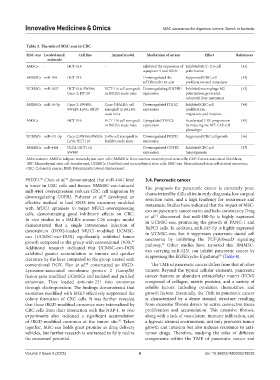
            Table 3. The role of MSC‑exo in CRC
            MSC‑exo  Loaded small   Cell line   Animal model    Mechanism of action     Effect       References
                     molecule
            AMSCs   -         HCT-116         -               Inhibited the expression of  Inhibited HCT-116 cell   [41]
                                                              aquaporin 5 and EGFR  polarization
            BMMSCs miR-100    HCT-116         -               Downregulated the   Suppressed CRC cell   [42]
                                                              mTOR/miR-143 axis  proliferation and metastasis
            UCMSCs miR-1827   HCT-116; SW480;   HCT-116 cell xenograft  Downregulating SUCNR1  Inhibited macrophage M2   [43]
                              Caco-2; HT-29   in BALB/c nude mice  expression   polarization; prevented
                                                                                colorectal liver metastasis
            BMMSCs miR-16-5p  Caco-2; SW480;   Caco-2 BALB/c cell   Downregulated ITGA2   Inhibited CRC cell   [44]
                              SW620; LoVo; HT29  xenograft in BALB/c   expression  proliferation,
                                              nude mice                         migration, and invasion
            AMSCs   -         HCT-116         HCT-116 cell xenograft  Upregulated TRPC3   Accelerated CRC progression   [45]
                                              in BALB/c nude mice  expression   by inducing the MT-CAF cell
                                                                                phenotype
            UCMSCs miR-431-5p  Caco-2; SW480; SW620;  LoVo cell xenograft in   Downregulated PRDX1   Suppressed CRC cell growth  [46]
                              LoVo; HCT 116   BALB/c nude mice  expression
            BMMSCs miR-4461   DLD1; HCT116;   -               Downregulated COPB2   Inhibited CRC cell   [47]
                              SW480                           expression        tumorigenesis
            Abbreviations: AMSCs: Adipose mesenchymal stem cells; BMMSCs: Bone marrow mesenchymal stem cells; CAF: Cancer-associated fibroblasts;
             MT: Mesenchymal stem cell-transformed; UCMSCs: Umbilical cord mesenchymal stem cells; MSC-exo: Mesenchymal stem cell-derived exosomes;
            CRC: Colorectal cancer; DLD: Deterministic lateral displacement.

            PRDX1.  Chen et al.  demonstrated that miR-4461 level   3.4. Pancreatic cancer
                             47
                  46
            is lower in CRC cells and tissues. BMMSC-exo-induced   The  prognosis  for  pancreatic  cancer  is  extremely  poor,
            miR-4461 overexpression reduces CRC cell migration by   characterized by difficulties in early diagnosis, low surgical
            downregulating  COPB2. Pishavar  et al.  developed an   resection  rates, and  a high  tendency for recurrence  and
                                             48
            effective method to load SN38 into exosomes modified   metastasis. Studies have indicated that the impact of MSC-
            with  MUC1 aptamers to target MUC1-overexpressing   exo on pancreatic cancer varies and lacks consistency. Ding
            cells, demonstrating good inhibitory effects on CRC.   et al.  discovered that miR-100-5p is highly expressed
                                                                   51
            In vivo  studies  in  a  BALB/c  mouse  C26  ectopic  model   in UCMSC-exo, promoting the growth of PANC-1 and
            demonstrated that a single intravenous injection of   BxPC3 cells. In addition, miR-145-5p is highly expressed
            doxorubicin (DOX)-loaded MUC1-modified UCMSC-      in UCMSC-exo, but it suppresses pancreatic ductal cell
            exo (UCMSC-exo-DOX) significantly inhibited tumor   carcinoma  by  inhibiting  the  TGF-β/Smad3  signaling
            growth compared to the group with conventional DOX.    pathway.  Other studies have reported that BMMSC-
                                                         49
                                                                      52
            Additional  research indicated that  UCMSC-exo-DOX   exo carrying miR-1231 can inhibit pancreatic cancer by
            exhibited greater accumulation in tumors and quicker   suppressing the EGFR/cyclin E pathway  (Table 4).
                                                                                              53
            clearance by the liver compared to the group treated with
            conventional  DOX.  Han  et al.   constructed  an  iRGD-  The TME of pancreatic cancer differs from that of other
                                     50
            Lysosome-associated membrane protein 2 (Lamp2b)    tumors. Beyond the typical cellular elements, pancreatic
            fusion gene-modified UCMSCs and isolated and purified   cancer  features  an abundant  extracellular  matrix  (ECM)
            exosomes. They loaded anti-mir-221 into exosomes   composed of collagen, matrix proteins, and a variety of
            through electroporation. The findings demonstrated that   soluble  factors,  including  cytokines,  chemokines,  and
            exosomes modified with iRGD effectively suppressed the   growth factors. Essentially, the TME in pancreatic cancer
            colony formation of CRC cells. It was further revealed   is  characterized  by  a  dense  stromal  structure  resulting
            that these iRGD-modified exosomes were internalized by   from excessive fibrosis driven by active connective tissue
            CRC cells from their interaction with the NRP-1. In vivo   proliferation and accumulation. This extensive fibrosis,
            experiments  also  indicated  a  significant  accumulation   along with a lack of vasculature, immune infiltration, and
            of iRGD-modified exosomes at the tumor site.  Taken   a hypoxic stromal environment, not only promotes tumor
                                                   50
            together, MSC-exo holds great promise as drug delivery   growth and invasion but also induces resistance to anti-
            vehicles, but further research is warranted to fully realize   tumor drugs. Therefore, studying the roles of different
            the exosomes’ potential.                           components within the TME of pancreatic cancer and


            Volume 2 Issue 3 (2025)                         6                           doi: 10.36922/IMO025210025

