


Page 117 - ITPS-7-1
P. 117
INNOSC Theranostics and
            Pharmacological Sciences                                            Repurposed Drugs as inhibitors of Pfmrk


            Plasmodium ovale, and  Plasmodium malariae. Among   substrate of Pfmrk . While it has been demonstrated that
                                                                              [5]
            these, P. falciparum is associated with the most severe and   plasmodial CDKs can be inhibited by mammalian CDK
            potentially fatal cases of malaria. According to the World   inhibitors , the existence of CDK inhibitory proteins in
                                                                       [6]
            Health Organization (WHO), a staggering 300 – 500 million   Plasmodium remains undiscovered. Therefore, Pfmrk holds
            malaria cases are reported annually, with the majority of   promise as a drug target in antimalarial drug screening.
            these cases occurring in Africa. High prevalence is also   In the present study, we have leveraged this foundational
            observed in regions such as India, Sri Lanka, Thailand,   knowledge to determine the potential of selected drugs to
            Indonesia, Vietnam, China, and Cambodia. In addition,   interact with and potentially inhibit the Pfmrk protein.
            malaria claims the lives of more than 2 million individuals   The extensive molecular docking and simulation study
            each year .
                   [2]
                                                               identified two  promising  candidate  drugs.  These drugs
              The parasite’s complex life cycle involves plasmodial   warrant further investigation in in vitro studies, with the
            cyclin-dependent kinases (CDKs) and cyclin proteins for   aim of their potential addition to drug panels for malaria
            its persistence in both vertebrate and invertebrate hosts .   treatment in the future.
                                                        [3]
            These proteins play essential roles in the parasite’s survival,
            both extracellularly and intracellularly. Plasmodial CDKs,   2. Materials and methods
            such as Pfmrk, belong to the Apicomplex, a specific protein   2.1. Sequence homology between Pfmrk and hCDK7
            kinase subfamily analogous to CDKs. Pfmrk, akin to CDK7,
            functions as an upstream kinase, facilitating the activation   Sequence homology between Pfmrk and hCDK7 was
            of multiple CDKs during a cell cycle . It is also known as   assessed through multiple sequence alignment, employing
                                         [4]
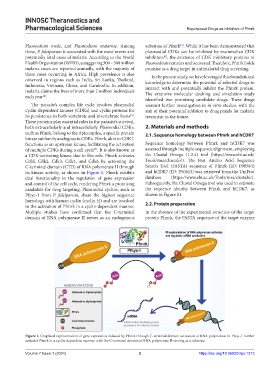
            a CDK-activating kinase due to this role. Pfmrk activates   the  Clustal  Omega  (1.2.4)  tool  (https://www.ebi.ac.uk/
            Cdkl, Cdk2, Cdk3, Cdk4, and Cdk6 by activating the   Tools/msa/clustalo/). The Fast Amino Acid Sequence
            C-terminal domain (CTD) of RNA polymerase II through   Search Tool (FASTA) sequence of Pfmrk (ID: P90584)
            its kinase activity, as shown in  Figure  1. Pfmrk exhibits   and hCDK7 (ID: P50613) was retrieved from the UniProt
            dual  functionality  in  the  regulation  of  gene  expression   database  (https://www.ebi.ac.uk/Tools/msa/clustalo/).
            and control of the cell cycle, rendering Pfmrk a promising   Subsequently, the Clustal Omega tool was used to estimate
            candidate for drug targeting. Plasmodial cyclins, such as   the sequence identity between Pfmrk and hCDK7, as
            Pfcyc-1 from  P. falciparum, share the highest sequence   shown in Figure S1.
            homology with human cyclin (cyclin H) and are involved
            in the activation of Pfmrk in a cyclin-dependent manner.   2.2. Protein preparation
            Multiple studies have confirmed that the C-terminal   In the absence of the experimental structure of the target
            domain of RNA polymerase II serves as an endogenous   protein Pfmrk, the FASTA sequence of the target enzyme


            Figure 1. Graphical representation of gene expression induced by Pfmrk through C-terminal domain activation of RNA polymerase II. Pfcyc-1 further
            activates Pfmrk in a cyclin-dependent manner, with the C-terminal domain of RNA polymerase II serving as a substrate.

            Volume 7 Issue 1 (2024)                         2                         https://doi.org/10.36922/itps.1313

