


Page 121 - ITPS-7-1
P. 121
INNOSC Theranostics and
            Pharmacological Sciences                                            Repurposed Drugs as inhibitors of Pfmrk


                         A                                   B


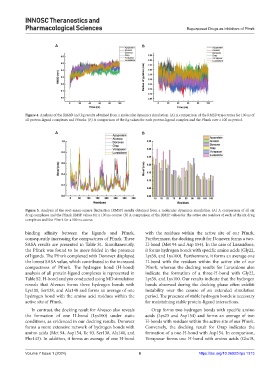
            Figure 4. Analysis of the RMSD and Rg results obtained from a molecular dynamics simulation. (A) A comparison of the RMSD trajectories for 100 ns of
            all protein-ligand complexes and Pfmrks. (B) A comparison of the Rg values for each protein-ligand complex and the Pfmrk over a 100 ns period.

                         A                                   B


            Figure 5. Analysis of the root-mean-square fluctuation (RMSF) results obtained from a molecular dynamics simulation. (A) A comparison of all six
            drug complexes and the Pfmrk RMSF values for a 100 ns course. (B) A comparison of the RMSF values for the active site residues of each of the six drug
            complexes and the Pfmrk for a 100 ns course.

            binding affinity between the ligands and Pfmrk,    with the residues within the active site of our  Pfmrk.
            consequently increasing the compactness of Pfmrk. These   Furthermore, the docking result for Donovex forms a two-
            SASA results are presented in Table S1.  Simultaneously,   H-bond (Met 94 and Asp 154). In the case of Lurasidone,
            the Pfmrk was found to be more folded in the presence   it forms hydrogen bonds with specific amino acids (Gly22,
            of ligands. The Pfmrk complexed with Donovex displayed   Lys39, and Lys100). Furthermore, it forms an average one
            the lowest SASA value, which contributed to the increased   H-bond with the residues within the active site of our
            compactness of Pfmrk. The hydrogen bond (H-bond)   Pfmrk, whereas the docking results for Lurasidone also
            analysis of all protein-ligand complexes is represented in   indicate the formation of a three-H-bond with Gly22,
            Table S2. H-bond analysis conducted using MD simulation   Lys39, and Lys100. Our results indicate that the hydrogen
            reveals that Alvesco forms three hydrogen bonds with   bonds observed during the docking phase often exhibit
            Lys100, Ser138, and Ala140 and forms an average of one   instability  over  the  course  of  an  extended  simulation
            hydrogen bond with the amino acid residues within the   period. The presence of stable hydrogen bonds is necessary
            active site of Pfmrk.                              for maintaining stable protein-ligand interactions.

              In contrast, the docking result for Alvesco also reveals   Orap forms two hydrogen bonds with specific amino
            the formation of one H-bond (Lys100) under static   acids (Lys23 and Asp154) and forms an average of two
            conditions, as evidenced in our docking results. Donovex   H-bonds with residues within the active site of our Pfmrk.
            forms a more extensive network of hydrogen bonds with   Conversely, the docking result for Orap indicates the
            amino acids (Met 94, Asp154, Ile 93, Ser138, Ala140, and   formation of a one-H-bond with Asp154. In comparison,
            Phe143). In addition, it forms an average of one H-bond   Vorapaxar forms one H-bond with amino  acids (Glu18,


            Volume 7 Issue 1 (2024)                         6                         https://doi.org/10.36922/itps.1313

