


Page 120 - ITPS-7-1
P. 120
INNOSC Theranostics and
            Pharmacological Sciences                                            Repurposed Drugs as inhibitors of Pfmrk


            A                                   B                               C


                              D                              E


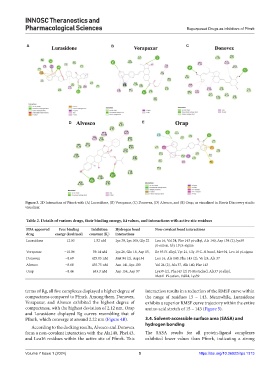
            Figure 3. 2D Interaction of Pfmrk with (A) Lurasidone, (B) Vorapaxar, (C) Donovex, (D) Alvesco, and (E) Orap, as visualized in Biovia Discovery studio
            visualizer.


            Table 2. Details of various drugs, their binding energy, Ki values, and interactions with active site residues
            FDA‑approved   Free binding   Inhibition   Hydrogen bond   Non‑covalent bond interactions
            drug        energy (kcal/mol)  constant (K )  interactions
                                               i
            Lurasidone      −12.03       1.52 nM  Lys 39, Lys 100, Gly 22  Leu 16, Val 24, Phe 143 pi-alkyl, Ala 140, Asp 154 (2), lys39
                                                                   pi-anion, Gly 19 pi-sigma
            Vorapaxar       −10.06      39.14 nM  Lys 26, Glu 18, Asp 15,  Ile 93 Pi-alkyl, Tyr 21, Gly 19 C-H bond, Met 94, Leu 16 pi-sigma
            Donovex          −8.69      429.05 nM  Met 94 (2), Asp154  Leu 16, Ala 140, Phe 143 (2), Va l24, Ala 37
            Alvesco          −8.68      435.75 nM  Asn 141, Lys 100  Val 24 (2), Ala 37, Ala 140, Phe 143
            Orap             −8.46      633.3 nM  Asp 154, Asp 97  Lys39 (2), Phe143 (2) Pi-Pi stacked, Ala37 pi alkyl,
                                                                   Met41 Pi cation, Val24, Lys39

            terms of Rg, all five complexes displayed a higher degree of   interaction results in a reduction of the RMSF curve within
            compactness compared to Pfmrk. Among them, Donovex,   the range of residues 15 – 143. Meanwhile, Lurasidone
            Vorapaxar, and Alvesco exhibited the highest degree of   exhibits a superior RMSF curve trajectory within the entire
            compactness, with the highest deviation of 2.12 nm. Orap   amino acid stretch of 15 – 143 (Figure 5).
            and Lurasidone displayed Rg curves resembling that of
            Pfmrk, which converge at around 2.22 nm (Figure 4B).  3.4. Solvent-accessible surface area (SASA) and
                                                               hydrogen bonding
              According to the docking results, Alvesco and Donovex
            form a non-covalent interaction with the Ala140, Phe143,   The SASA results for all protein-ligand complexes
            and Leu16 residues within the active site of Pfmrk. This   exhibited lower values than Pfmrk, indicating a strong


            Volume 7 Issue 1 (2024)                         5                         https://doi.org/10.36922/itps.1313

