


Page 44 - JCAU-4-1
P. 44
Two Water Towns in the Qingpu District of Shanghai                                                                            Semprebon


               1.  INTRODUCTION:           FRAGILITIES
                    AND UNCERTAINTIES
               Since the Open-Door policy implementation
               in  1978,  domestic  tourism  in  China  gained
               constant  impulse  from  the  new  economic
               system  based  on  state-oriented  capitalistic
               mechanisms. Immersed in a heritage setting
               or traditional ambiences, a growing number
               of  historical  settlements  have  witnessed
               development strategies where tourism played
               a  fundamental  and  guiding  role.  In  many
               cases,  despite  such  plans  having  envisaged
               grotesque  forms,  materialising  threats  and
               losses  to  the  consistency  of  tangible  and
               intangible local culture, the tourism industry
               has  also  revitalised  local  economies  by
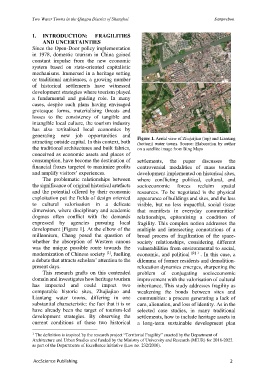
               generating  new  job  opportunities  and       Figure 1. Aerial view of Zhujaijiao (top) and Liantang
               attracting outside capital. In this context, both   (bottom) water towns. Source: Elaboration by author
               the traditional architectures and built fabrics,   on a satellite image from Bing Maps
               conceived as economic assets and places of
               consumption, have become the destination of    settlements,  the   paper    discusses  the
               financial fluxes targeted to maximize profits   controversial  modalities  of  mass  tourism
               and amplify visitors’ experiences.             development implemented on historical sites,
                    The  problematic  relationships  between   where  conflicting  political,  cultural,  and
               the significance of original historical artefacts   socioeconomic   forces   reclaim   spatial
               and the potential offered by their economic    resources.  To  be  negotiated  is  the  physical
               exploitation put the fields of design oriented   appearance of buildings and sites, and the less
               to  cultural  valorisation  in  a  delicate    visible,  but  no  less  impactful,  social  tissue
               dimension, where disciplinary and academic     that  manifests  in  everyday  communities’
               dogmas  often  conflict  with  the  demands    relationships,  epitomising  a  condition  of
               expressed  by  agencies  pursuing  local       fragility. This complex notion addresses the
               development [Figure 1]. At the elbow of the    multiple  and  intersecting  connotations  of  a
               millennium,  Cheng  posed  the  question  of   broad  process  of  fragilization  of  the  space-
               whether  the  absorption  of  Western  canons   society  relationships,  considering  different
               was  the  unique  possible  route  towards  the   vulnerabilities from environmental to social,
                                                [1]
                                                                                      [2] 1
               modernization of Chinese society  , fuelling   economic, and political     . In this case, a
               a debate that attracts scholars’ attention to the   dilemma of former residents and demolition-
               present days.                                  relocation dynamics emerges, sharpening the
                    This  research  grafts  on  this  contended   problem  of  conjugating  socioeconomic
               domain and investigates how heritage tourism   improvement with the valorisation of cultural
               has  impacted  and  could  impact  two         inheritance. This study addresses fragility as
               comparable  historic  sites,  Zhujiajiao  and   weakening  the  bonds  between  sites  and
               Liantang  water  towns,  differing  in  one    communities: a process generating a lack of
               substantial characteristic: the fact that it is or   care, alienation, and loss of identity. As in the
               have  already  been  the  target  of  tourism-led   selected  case  studies,  in  many  traditional
               development  strategies.  By  observing  the   settlements, how to include heritage assets in
               current   conditions   of   these   two   historical   a  long-term  sustainable  development  plan

               1  The definition is inspired by the research project “Territorial Fragility” enacted by the Department of
               Architecture and Urban Studies and funded by the Ministry of University and Research (MIUR) for 2018-2022
               as part of the Departments of Excellence initiative (Law no. 232/2016).


                AccScience Publishing                                                                  2

