


Page 53 - JCAU-5-4
P. 53
Journal of Chinese
            Architecture and Urbanism                                                   Learning from the countryside


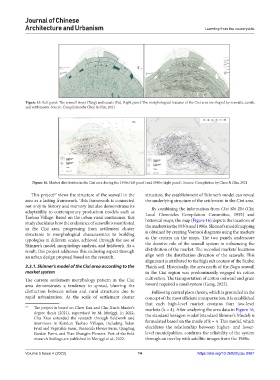
            Figure 15. Left panel: The seawall rivers (Tang) and canals (Pu). Right panel: The morphological features of the Cixi area are shaped by seawalls, canals,
            and settlements. Source: Compilation by Chen & Chu, 2021


               Figure 16. Market distribution in the Cixi area during the 1930s (left panel) and 1980s (right panel). Source: Compilation by Chen & Chu, 2021

              This project  views the structure of the seawall in the   structure, the establishment of Skinner’s model can reveal
                        12
            area as a lasting framework. This framework is connected   the underlying structure of the settlement in the Cixi area.
            not only to history and memory but also demonstrates its   By combining the information from Cixi Shi Zhi (Cixi
            adaptability to contemporary production models such as   Local  Chronicles  Compilation  Committee,  1992)  and
            Taobao Village. Based on the urban-rural continuum, this
            study elucidates how the endurance of seawalls is manifested   historical maps, the map (Figure 16) depicts the locations of
            in the Cixi area, progressing from settlement cluster   the markets in the 1930s and 1980s. Skinner’s model mapping
            structures to morphological characteristics to building   is obtained by creating Voronoi diagrams using the markets
            typologies at different scales, achieved through the use of   as the centers on the maps. The two panels underscore
            Skinner’s model, morphology analysis, and fieldwork. As a   the decisive role of the seawall system in influencing the
            result, this project addresses this enduring aspect through   distribution of the market. The recorded markets’ locations
            an urban design proposal based on the research.    align with the distribution direction of the seawalls. This
                                                               alignment is attributed to the high salt content of the Sanbei
            3.3.1. Skinner’s model of the Cixi area according to the   Plain’s soil. Historically, the area north of the Dagu seawall
            market system                                      in  the  Cixi  region  was  predominantly  engaged  in  cotton

            The  current  settlement  morphology  pattern  in  the  Cixi   cultivation. The transportation of cotton outward and grain
            area  demonstrates  a  tendency  to  spread,  blurring  the   inward required a canal system (Geng, 2022).
            distinction between urban and rural structures due to   Following central place theory, which is grounded in the
            rapid urbanization. At the scale of settlement cluster   concept of the most efficient transportation, it is established
                                                               that  each  high-level  market  contains  four  low-level
            12    The project is based on Chen Kan and Chu Xiao’s Master’s   markets (k = 4). After analyzing the area data in Figure 16,
               degree thesis (2021), supervised by M. Meriggi. In 2022,
               Chu Xiao extended the research through fieldwork and   the standard hexagon model (standard Skinner’s Model) is
               interviews in Kandun Taobao Villages, including Yulan   formulated based on the mode of k = 4. This model, which
               Fruit and Vegetable Farm, Peninsula Flower Farm, Qingting   elucidates the relationship between higher-  and lower-
               Garden Farm, and Tian Shangjin Flowers. Part of the field   level municipalities, confirms the reliability of the system
               research findings are published in Meriggi et al., 2022.  through an overlay with satellite images from the 1980s.


            Volume 5 Issue 4 (2023)                         14                       https://doi.org/10.36922/jcau.0981

