


Page 68 - JCTR-10-1
P. 68
64                        Zhuang et al. | Journal of Clinical and Translational Research 2024; 10(1): 62-71
        C-index  and  calibration  curve.  Based  on  the  nomogram  score,   Table 1. Patient and tumor characteristics in 171 patients with primary
        patients  were  stratified  into  low-,  intermediate-,  and  high-risk   retroperitoneal myxoid/round cell liposarcoma
        groups. Survival differences between these groups were compared   Characteristics       N=171        % of total
        using  the  Kaplan–Meier  curve  and  the  log-rank  test.  The  risk   Gender
        stratification  cutoff  point  was  determined  using  X-tile,  a  novel   Male           92           53.8
        bioinformatics tool for biomarker assessment and outcome-based   Female                   79           46.2
        cut-point optimization.                                  Age, years median (range)     64 (24 – 92)
          All tests were conducted with two-tailed statistics, and P < 0.05   Marital status
        was considered statistically significant. Data were analyzed using   Married              92           53.8
        R statistical software (version 4.1.2, http://www.r-project.org).  Single                 31           18.1
        3. Results                                                Widowed                         24           14.0
                                                                  Divorced                        15            8.8
        3.1. Patient and tumor characteristics                    Separated                       2             1.2
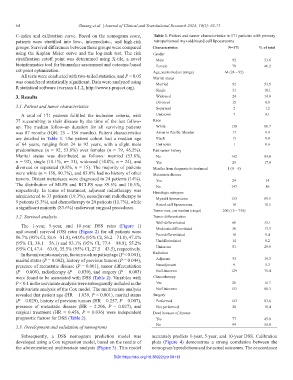
          A  total  of  171  patients  fulfilled  the  inclusion  criteria,  with   Unknown       7             4.1
        77  succumbing  to  their  disease  by  the  time  of  the  last  follow-  Race
        up.  The  median  follow-up  duration  for  all  surviving  patients   White              138          80.7
        was 87 months (IQR: 25 – 156 months). Patient characteristics   Asian or Pacific Islander  17           9.9
        are  detailed  in  Table  1.  The  patient  cohort  had  a  median  age   Black           15            8.8
        of  64  years,  ranging  from  24  to  92  years,  with  a  slight  male   Unknown        1             0.6
        predominance  (n  =  92,  53.8%)  over  females  (n  =  79,  46.2%).   Past tumor history
        Marital  status  was  distributed  as  follows:  married  (53.8%,   No                    142          83.0
        n = 92), single (18.1%, n= 31), widowed (14.0%, n = 24), and   Yes                        29           17.0
        divorced or separated (8.8%, n = 15). The majority of patients   Months from diagnosis to treatment  1 (0 – 6)
        were white (n = 138, 80.7%), and 83.0% had no history of other   Metastasis disease
        tumors. Distant metastases were diagnosed in 24 patients (14%).   Yes                     24            14
        The  distribution  of  MLPS  and  RCLPS  was  89.5%  and  10.5%,   No                     147           86
        respectively.  In  terms  of  treatment,  adjuvant  radiotherapy  was   Histologic subtypes
        administered to 33 patients (19.3%), neoadjuvant radiotherapy to   Myxoid liposarcoma     153          89.5
        9 patients (5.3%), and chemotherapy to 20 patients (11.7%), while   Round cell liposarcoma  18         10.5
        a significant majority (83.6%) underwent surgical procedures.
                                                                 Tumor size, cm median (range)  200 (15 – 750)
        3.2. Survival analysis                                   Tumor differentiation
                                                                  Well-differentiated             60           35.1
          The  1-year,  5-year,  and  10-year  DSS  rates  (Figure  1)
        and overall survival (OS) rates (Figure 2) for all patients were   Moderate-differentiated  30         17.5
                                                                  Poor-differentiated
                                                                                                                9.4
                                                                                                  16
        86.7% (95% CI, 81.6 – 81.8), 64.0% (95% CI, 56.2 – 71.8), 47.1%
        (95% CI, 38.1 – 56.1) and 83.1% (95% CI, 77.4 – 88.8), 55.2%   Undifferentiated           14            8.2
        (95% CI, 47.4 – 63.0), 35.5% (95% CI, 27.5 – 43.5), respectively.  Unknown                51           29.8
          In the univariate analysis, factors such as patient age (P < 0.001),   Radiation
        marital status (P = 0.002), history of previous tumors (P = 0.044),   Adjuvant            33           19.3
        presence of metastatic disease (P = 0.001), tumor differentiation   Neoadjuvant           9             5.3
        (P = 0.009), radiotherapy (P = 0.030), and surgery (P = 0.003)   No/Unknown               129          75.4
        were found to be associated with DSS (Table 2). Variables with   Chemotherapy
        P < 0.1 in the univariate analysis were subsequently included in the   Yes                20           11.7
        multivariate analysis of the Cox model. The multivariate analysis   No/Unknown            151          88.3
        revealed that patient age (HR = 1.039, P < 0.001), marital status   Surgery
        (P = 0.029), history of previous tumors (HR = 0.257, P = 0.007),   Performed              143          83.6
        presence  of  metastatic  disease  (HR  =  2.206,  P  =  0.027),  and   Not performed     28           16.4
        surgical  treatment  (HR  =  0.456,  P  =  0.036)  were  independent   Dead because of disease
        prognostic factors for DSS (Table 2).                     Yes                             77           45.0
                                                                  No                              94           55.0
        3.3. Development and validation of nomograms
          Subsequently,  a  DSS  nomogram  prediction  model  was   accurately predicts 1-year, 5-year, and 10-year DSS. Calibration
        developed using a Cox regression model, based on the results of   plots (Figure  4)  demonstrate  a  strong  correlation  between  the
        the aforementioned multivariate analysis (Figure 3). This model   nomogram’s predictions and the actual outcomes. The concordance
                                                 DOI: https://doi.org/10.36922/jctr.00113

