


Page 71 - JCTR-10-1
P. 71
Zhuang et al. | Journal of Clinical and Translational Research 2024; 10(1): 62-71   67
                                                                liposarcoma. There were 177 patients in the study, and the 5-year
                                                                DSS for all patients was 60%. There were only 13 (7%) patients
                                                                with MLPS and RCLPS in the cohort, so the accuracy of prediction
                                                                for  these  patients  was  limited  even  though  pathological  type
                                                                was an independent prognostic factor for RLPS in multivariate
                                                                analysis [23]. Subsequently, MSKCC developed a DSS nomogram
                                                                prediction  model  using  data  from  801  liposarcoma  patients
                                                                (including 144 MLPS and 81 RCLPS). Despite the 12-year DSS
                                                                of 72% for the entire cohort, the 12-year DSS for liposarcomas
                                                                of  retroperitoneal  origin  in  subgroups  by  site  was  only  32%.
                                                                This is consistent with our previous findings that the prognosis
                                                                for retroperitoneal MLPS/RCLPS is worse than other sites. The
                                                                researchers also developed a 5-year and 12-year DSS prediction
                                                                model with good verification based on age, presentation status,
                                                                primary site, histologic variant, tumor burden, and gross margin
                                                                status (C-index = 0.776) [28]. Gronchi et al. developed a nomogram
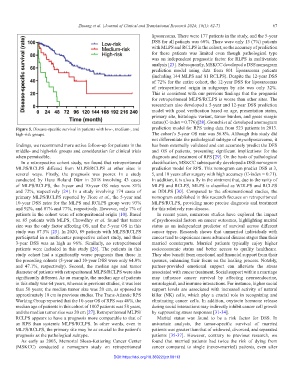
        Figure 5. Disease-specific survival in patients with low-, medium-, and   prediction model for RPS using data from 523 patients in 2013.
        high-risk groups.                                       The cohort’s 5-year OS rate was 56.8%. Although this study did
                                                                not differentiate the pathological subtype of myxoliposarcoma, it
        findings, we recommend more active follow-up for patients in the   has been externally validated and can accurately predict the DFS
        middle- and high-risk groups and consideration for clinical trials   and  OS  of  patients,  presenting  significant  implications  for  the
        when permissible.                                       diagnosis and treatment of RPS [29]. On the basis of pathological
          In a retrospective cohort study, we found that retroperitoneal   classification, MSKCC subsequently developed a DSS nomogram
        MLPS/RCLPS  differed  from  MLPS/RCLPS  at  other  sites  in   prediction model for RPS. This nomogram can predict DSS at 3,
        several  ways.  Firstly,  the  prognosis  was  poorer.  In  a  study   5, and 10 years after surgery with high accuracy (C-index = 0.71).
        conducted  by  Hans  Roland  Dürr  in  2018  involving  43  cases   In addition, it is also a fly in the ointment that, due to the rarity of
        of  MLPS/RCLPS,  the  5-year  and  10-year  OS  rates  were  81%   MLPS and RCLPS, MLPS is classified as WDLPS and RCLPS
        and  72%,  respectively  [24].  In  a  study  involving  174  cases  of   as  DDLPS  [30].  Compared  to  the  aforementioned  studies,  the
        primary MLPS/RCLPS reported by Fiore et al., the 5-year and   nomogram established in this research focuses on retroperitoneal
        10-year DSS rates for the MLPS and RCLPS group were 93%   MLPS/RCLPS, providing more precise diagnosis and treatment
        and 92%, and 87% and 77%, respectively. However, only 7% of   for this relatively rare disease.
        patients in the cohort were of retroperitoneal origin [10]. Based   In  recent  years,  numerous  studies  have  explored  the  impact
        on  85  patients  with  MLPS,  Chowdhry  et  al. found that  tumor   of psychosocial factors on cancer outcomes, highlighting marital
        size was the only factor affecting OS, and the 5-year OS in this   status  as  an  independent  predictor  of  survival  across  different
        study was 87.5% [25]. In 2020, 89 patients with MLPS/RCLPS   cancer  types.  Research  shows  that  unmarried  individuals  with
        participated in a multicenter prospective cohort study, and their   cancer tend to experience more advanced disease stages than their
        3-year  DSS  was  as  high  as  96%.  Similarly,  no  retroperitoneal   married  counterparts.  Married  patients  typically  enjoy  higher
        patients  were  included  in  this  study  [26].  The  patients  in  this   socioeconomic  status  and  better  access  to  quality  healthcare.
        study  cohort  had  a  significantly  worse  prognosis  than  those  in   They also benefit from emotional and financial support from their
        the preceding cohorts (5-year and 10-year DSS were only 64.0%   spouses, enhancing their focus on the healing process. Notably,
        and  47.1%,  respectively).  Second,  the  median  age  and  tumor   partner-provided  emotional  support  can  alleviate  the  stress
        diameter of patients with retroperitoneal MLPS/RCLPS were also   associated with cancer treatment. Social support within a marriage
        significantly different. As an example, the median age of patients   may  influence  cancer  survival  by  affecting  neuroendocrine,
        in this study was 64 years, whereas in previous studies, it was less   neurological, and immune interactions. For instance, higher social
        than 50 years; the median tumor size was 20 cm, as opposed to   support  levels  are  associated  with  increased  activity  of  natural
        approximately 10 cm in previous studies. The Trans-Atlantic RPS   killer  (NK)  cells,  which  play  a  crucial  role  in  recognizing  and
        Working Group reported that the 10-year OS of RPS was 46%, the   eliminating cancer cells. In addition, oxytocin hormone release
        median age of patients in this cohort of 1007 patients was 58 years,   during social interactions may indirectly inhibit cancer cell growth
        and the median tumor size was 20 cm [27]. Retroperitoneal MLPS/  by suppressing stress responses [31-34].
        RCLPS appears to have a prognosis more comparable to that of   Marital  status  was  found  to  be  a  risk  factor  for  DSS.  In
        an  RPS  than  systemic  MLPS/RCLPS.  In  other  words,  even  in   univariate  analysis,  the  tumor-specific  survival  of  married
        MLPS/RCLPS, the primary site may be as crucial to the patient’s   patients was greater than that of widowed, divorced, and separated
        prognosis as the pathological subtype.                  patients  [35-37].  However,  contrary  to  previous  research,  we
          As  early  as  2003,  Memorial  Sloan-Kettering  Cancer  Center   found  that  married  patients  had  twice  the  risk  of  dying  from
        (MSKCC)  conducted  a  nomogram  study  on  retroperitoneal   cancer  compared  to  single  (never-married)  patients,  even  after
                                                 DOI: https://doi.org/10.36922/jctr.00113

