


Page 37 - JCTR-10-2
P. 37
Abtahi et al. | Journal of Clinical and Translational Research 2024; 10(2): 119-140   131
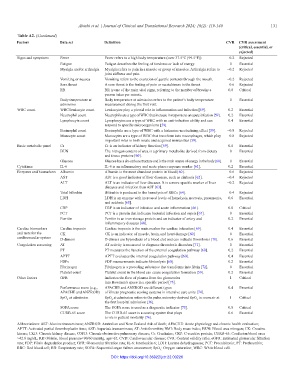
        Table A2. (Continued)
        Factors           Data set           Definition                                        CVR   CVR assessment
                                                                                                     (critical, essential, or
                                                                                                     rejected)
        Signs and symptoms  Fever            Fever refers to a high body temperature (over 37.5°C [99.5°F]).  −0.2  Rejected
                          Fatigue            Fatigue describes the feeling of tiredness or lack of energy.  0  Essential
                          Myalgia and/or arthralgia  Myalgia refers to pain in a muscle or group of muscles. Arthralgia refers to   −0.2  Rejected
                                             joint stiffness and pain.
                          Vomiting or nausea  Vomiting refers to the excretion of gastric contents through the mouth.  −0.2  Rejected
                          Sore throat        A sore throat is the feeling of pain or scratchiness in the throat.  −0.6  Rejected
                          RR                 RR is one of the main vital signs, referring to the number of breaths a   0.8  Critical
                                             person takes per minute.
                          Body temperature at   Body temperature at admission refers to the patient’s body temperature   0  Essential
                          admission          measurement during the first visit.
        WBC count         WBC/leukocyte count  Leukocytes play a pivotal role in inflammation and infection [59].  0.2  Essential
                          Neutrophil count   Neutrophils are a type of WBC that increase in response to an acute infection [59].  0.2  Essential
                          Lymphocyte count   Lymphocytes are a type of WBC with an anti-infection ability and can   0.4  Essential
                                             respond to specific microorganisms [59].
                          Eosinophil count   Eosinophils are a type of WBC with a histamine-neutralizing effect [59].  −0.8  Rejected
                          Monocyte count     Monocytes are a type of WBC that transform into macrophages, which play   −0.8  Rejected
                                             important roles in both innate and acquired immunities [59].
        Basic metabolic panel  Cr            Cr is an indicator of kidney function [59].        0.6  Essential
                          BUN                The nitrogen content of urea is a primary metabolite derived from dietary   0  Essential
                                             and tissue proteins [60].
                          Glucose            Glucose has a six-carbon structure and is the main source of energy in the body [60].  0  Essential
        Cytokines         IL-6               IL-6 is an inflammatory and acute phase response marker [61].  0.2  Essential
        Enzymes and biomarkers  Albumin      Albumin is the most abundant protein in blood [60].  −0.6  Rejected
                          AST                AST is a good indicator of liver diseases, such as cirrhosis [62].  −0.4  Rejected
                          ALT                ALT is an indicator of liver diseases. It is a more specific marker of liver   −0.2  Rejected
                                             diseases and infection than AST [63].
                          Total bilirubin    Bilirubin is produced in the hemolysis of RBCs [64].  −0.4  Rejected
                          LDH                LDH is an enzyme with increased levels of hemolysis, necrosis, pneumonia,   0.6  Essential
                                             and acidosis [65].
                          CRP                CRP is an indicator of infection and acute inflammation [66].  0.8  Critical
                          PCT                PCT is a protein that indicates bacterial infection and sepsis [67].  0  Essential
                          Ferritin           Ferritin is an iron-storage protein and an indicator of artery and   0.2  Essential
                                             inflammatory diseases [68].
        Cardiac biomarkers   Cardiac troponin  Cardiac troponin is the main marker for cardiac infarction [69].  0.4  Essential
        and tests for the   CK               CK is an indicator of muscle, brain, and heart damage [60]  0  Essential
        cardiovascular system  D-dimers      D-dimers are byproducts of a blood clot and can indicate thrombosis [70].  0.6  Essential
        Coagulation screening  AT            AT activity is measured to diagnose thrombotic disorders [71].  0  Essential
                          PT                 PT measures the function of the external coagulation pathway [60].  0.2  Essential
                          APTT               APTT evaluates the internal coagulation pathway [60].  0.4  Essential
                          FDPs               FDP measurements indicate fibrinolysis [60].       0.2  Essential
                          Fibrinogen         Fibrinogen is a preceding substance that transforms into fibrin [72].  0  Essential
                          Platelet count     Platelet count in the blood can cause coagulation formation [59].  0.2  Essential
        Other factors     GFR                Indicates the flow of plasma from the glomerulus    1   Critical
                                             into Bowman’s space in a specific period [73].
                          Performance score (e.g.,   APACHE and ANZROD are different types      0.4  Essential
                          APACHE and ANZROD)  of illness prognostic scoring systems in intensive care units [74].
                          SpO  at admission  SpO  at admission refers to the pulse oximetry-derived SpO  in room air at   1  Critical
                                                2
                                                                                   2
                             2
                                             the first hospital admission [36].
                          SOFA score         The SOFA score is used as a diagnostic indicator [75].  0.8  Critical
                          CURB-65 score      The CURB-65 score is a scoring system that plays    0.6  Essential
                                             a role in patient mortality [76].
        Abbreviations: ALT: Alanine transaminase; ANZROD: Australian and New Zealand risk of death; APACHE: Acute physiology and chronic health evaluation;
        APTT: Activated partial thromboplastin time; AST: Aspartate transaminase; AT: Anti-thrombin; BMI: Body mass index; BUN: Blood urea nitrogen; CK: Creatine
        kinase; CKD: Chronic kidney disease; COPD: Chronic obstructive pulmonary disease; Cr: Creatinine; CRP: C-reactive protein; CURB-65: Confusion blood urea
        >42.8 mg/dL, RR>30/min, blood pressure<90/60 mmHg, age>65; CVD: Cardiovascular disease; CVR: Content validity ratio; eGFR: Estimated glomerular filtration
        rate; FDP: Fibrin degradation product; GFR: Glomerular filtration rate; IL-6: Interleukin-6; LDH: Lactate dehydrogenase; PCT: Procalcitonin; PT: Prothrombin;
        RBC: Red blood cell; RR: Respiratory rate; SOFA: Sequential organ failure assessment; SpO : Oxygen saturation; WBC: White blood cell.
                                                                    2
                                                DOI: https://doi.org/10.36922/jctr.22.00226

