


Page 51 - JCTR-10-2
P. 51
Grondin et al. | Journal of Clinical and Translational Research 2024; 10(2): 141-150   145
        Table 3. Psychological assessments of patients with RA versus SpA  Table 3. (Continued)
        Psychological parameters  RA (n=27)  SpA (n=20)  P‑value  Psychological parameters  RA (n=27)  SpA (n=20)  P‑value
        Depression            21 (77.8%)   17 (85%)    0.713     Professional impact                           0.006*
        Depression intensity                           0.197      Mild/moderate         17 (68%)    5 (26.3%)
         Mild/moderate        16 (76.2%)  16 (94.1%)              Severe                8 (32%)    14 (73.7%)
         Severe                5 (23.8%)   1 (5.9%)              Manual labor          12 (44.4%)   16 (80%)   0.014*
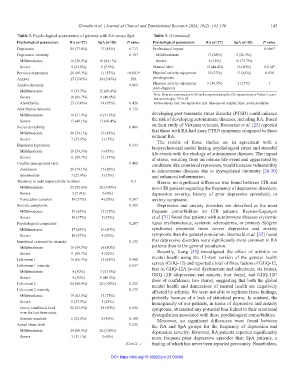
        Previous depression   26 (96.3%)   11 (55%)   <0.001*    Physical activity enjoyment   10 (37%)  13 (65%)  0.058
        Anxiety                27 (100%)   20 (100%)    NA       pre-diagnosis
        Anxiety intensity                              0.069     Physical activity enjoyment   5 (18.5%)  3 (15%)  1
         Mild/moderate         9 (33.3%)  12 (60.0%)             post-diagnosis
         Severe               18 (66.7%)   8 (40.0%)             Note: Data are expressed as n (%) and compared using the Chi-squared test or Fisher’s exact
                                                                 test accordingly; *P<0.05.
         Alexithymia           27 (100%)   19 (95%)    0.426     Abbreviations: NA: Not applicable; RA: Rheumatoid arthritis; SpA: spondyloarthritis.
        Alexithymia intensity                          0.172
         Mild/moderate        14 (51.9%)   6 (31.6%)            developing post-traumatic stress disorder (PTSD) could enhance
         Severe               13 (48.1%)  13 (68.4%)            the risk of developing autoimmune diseases, including RA. Based
        Social desirability                            0.481    on their study of Vietnam veterans, Boscarino et al. [25] reported
         Mild/moderate        20 (74.1%)   17 (85%)             that those with RA had more PTSD symptoms compared to those
         Severe                7 (25.9%)   3 (15%)              without RA.
                                                                   The results of those studies are in agreement  with a
        Emotional repression                           0.333    biopsychosocial model linking psychological stress and stressful
         Mild/moderate        16 (59.3%)   9 (45%)              life events with the etiology of autoimmune diseases. The impact
         Severe               11 (40.7%)   11 (55%)             of stress, resulting from an intense life event and aggravated by
        Conflict-management style                      0.481    conditions like emotional repression, would increase vulnerability
         Avoidance            20 (74.1%)   17 (85%)             to autoimmune diseases due to dysregulated immunity  [26-30]
         Intermediate          7 (25.9%)   3 (15%)              and enhanced inflammation.
        Tendency to cede responsibility to others       0.5        Herein, no significant difference was found between CIR and
         Mild/moderate        25 (92.6%)   20 (100%)            non-CIR patients regarding the frequency of depression disorders,
         Severe                2 (7.4%)     0 (0%)              depression  severity,  history  of  prior  depressive  episode(s),  or
         Persecution complex   10 (37%)    4 (20%)     0.207    anxiety symptoms.
        Somatic complaints                             0.381       Depressive  and  anxiety  disorders  are  described  as  the  most
         Mild/moderate         17 (63%)    15 (75%)             frequent  comorbidities  for  CIR  patients.  Reynier-Legarçon
         Severe                10 (37%)    5 (25%)              et al. [31] found that patients with autoimmune diseases (systemic
        Psychological complaints                       0.207    lupus erythematosus, systemic scleroderma, or primary Sjögren
         Mild/moderate         17 (63%)    16 (80%)             syndrome)  presented  more  severe  depressive  and  anxiety
         Severe                10 (37%)    4 (20%)              symptoms than the general population. Baerwald et al. [32] found
        Emotional expressivity intensity               0.132    that depressive disorders were significantly more common in RA
         Mild/moderate        16 (59.3%)   16 (80%)             patients than in the general population.
         Severe               11 (40.7%)   4 (20%)                 Recently,  Kang  [33]  investigated  the  effect  of  arthritis  on
        Life event 1          16 (66.7%)   13 (65%)    0.908    mental  health  using  the  12-item  version  of  the  general  health
        Life event 1 intensity                         0.837    survey (GHQ-12) and reported a total of three factors of GHQ-12,
         Mild/moderate         8 (50%)     7 (53.8%)            that is, GHQ-12A (social dysfunction and anhedonia; six items),
         Severe                8 (50%)     6 (46.2%)            GHQ-12B (depression and anxiety; four items), and GHQ-12C
        Life event 2          24 (88.9%)   20 (100%)   0.251    (loss of confidence; two items), suggesting that both the global
                                                                mental  health  and  dimensions  of mental  health  are  negatively
        Life event 2 intensity                         0.375    affected by arthritis. We were not able to replicate those findings,
         Mild/moderate        15 (62.5%)   15 (75%)             probably because of a lack of statistical power. In contrast, the
         Severe                9 (37.5%)   5 (25%)              homogeneity of our patients, in terms of depressive and anxiety
         Heavy conflictual load   22 (81.5%)  18 (90%)  0.682   symptoms, attenuated any potential bias linked to their emotional
         over the last three years                              dysregulation associated with these psychological comorbidities.
         Somatic escalade      6 (22.2%)   8 (40%)     0.188       Moreover,  no  significant  differences  were  found  between
        Actual stress level                            0.251    the  RA  and  SpA  groups  for  the  frequency  of  depression  and
         Mild/moderate        24 (88.9%)   20 (100%)            depression severity. However, RA patients reported significantly
         Severe                3 (11.1%)    0 (0%)              more  frequent  prior  depressive  episodes  than  SpA  patients,  a
                                                     (Cont’d...)  finding of which has never been reported previously. Nonetheless,

                                                DOI: https://doi.org/10.36922/jctr.23.00099

