


Page 52 - JCTR-10-2
P. 52
146                       Grondin et al. | Journal of Clinical and Translational Research 2024; 10(2): 141-150
        Table 4. Psychological assessments of patients with versus without BIS  Table 4. (Continued)
        Psychological parameters  With BIS   Without BIS   P‑value  Psychological parameters  With BIS   Without BIS   P‑value
                               (n=16)       (n=31)                                      (n=16)       (n=31)
        Depression            13 (81.3%)   25 (80.6%)   1        Professional impact                            0.75
        Depression intensity                            1         Mild/moderate         8 (53.3%)   14 (48.3%)
         Mild/moderate        11 (84.6%)   21 (84.0%)             Severe                7 (46.7%)   15 (51.7%)
         Severe                2 (15.4%)   4 (16.0%)             Manual labor           8 (50%)     20 (64.5%)  0.337
        Previous depression   14 (87.5%)   23 (74.2%)  0.457     Physical activity      7 (43.8%)   16 (51.6%)  0.609
        Anxiety                16 (100%)   31 (100%)    NA       enjoyment pre-diagnosis
        Anxiety intensity                              0.252     Physical activity enjoyment   3 (18.8%)  5 (16.1%)  1
         Mild/moderate         9 (56.3%)   12 (38.7%)            post-diagnosis
         Severe                7 (43.8%)   19 (61.3%)            Note: Data are expressed as n (%) and compared using the Chi-squared test or Fisher’s
                                                                 exact test accordingly; *P<0.05.
        Alexithymia            16 (100%)   30 (96.8%)   1        Abbreviations: BIS: Biological inflammatory syndrome; NA: Not applicable.
        Alexithymia intensity                          0.222
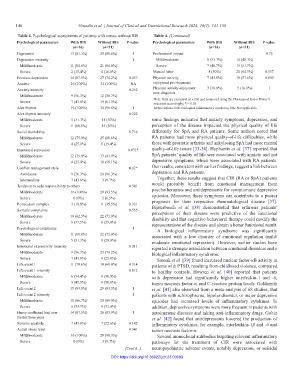
         Mild/moderate         5 (31.3%)   15 (50%)             some findings indicated that anxiety symptoms, depression, and
         Severe               11 (68.8%)   15 (50%)             perception  of  the  disease  impacted  the  physical  quality  of  life
        Social desirability                            0.716    differently  for  SpA  and  RA  patients.  Some  authors  noted  that
         Mild/moderate        12 (75.0%)   25 (80.6%)           RA patients had more physical quality-of-life difficulties, while
         Severe                4 (25.0%)   6 (19.4%)            those with psoriatic arthritis and ankylosing SpA had more mental
        Emotional repression                          0.031*    quality-of-life issues [33-36]. Hyphantis et al. [37] reported that
         Mild/moderate        12 (75.0%)   13 (41.9%)           SpA patients’ quality of life was associated with anxiety and not
         Severe                4 (25.0%)   18 (58.1%)           depressive symptoms, which were associated with RA patients.
        Conflict-management style                      0.02*    Our results, consistent with earlier findings, suggest a link between
         Avoidance             9 (56.3%)   28 (90.3%)           depression and RA patients.
         Intermediate          7 (43.8%)    3 (9.7%)               Together, these results suggest that CIR (RA or SpA) patients
        Tendency to cede responsibility to others      0.541    would  probably  benefit  from  emotional  management  from
         Mild/moderate         16 (100%)   29 (93.5%)           psychotherapists and antidepressants for symptomatic depressive
         Severe                 0 (0%)      2 (6.5%)            episodes. Moreover, these symptoms can contribute to a poorer
        Persecution complex    3 (18.8%)   11 (35.5%)  0.321    prognosis for their  respective  rheumatological  disease  [37].
                                                                Bijsterbosch et  al. [38] demonstrated  that  arthrosis  patients’
        Somatic complaints                             0.555
         Mild/moderate        10 (62.5%)   22 (71.0%)           perceptions  of  their  disease  were  predictive  of  the  functional
                                                                disability and that cognitive-behavioral therapy could modify the
         Severe                6 (37.5%)   9 (29.0%)            representations of the disease and obtain a better functional result.
        Psychological complaints                        1          A  biological  inflammatory  syndrome  was  significantly
         Mild/moderate        11 (68.8%)   22 (71.0%)           associated  with  a  low  disorder  of  emotional  regulation  (mild/
         Severe                5 (31.3%)   9 (29.0%)            moderate  emotional  repression).  However,  earlier  studies  have
        Emotional expressivity intensity               0.211    reported a stronger association between emotional disorders and a
         Mild/moderate         9 (56.3%)   23 (74.2%)           biological inflammatory syndrome.
         Severe                7 (43.8%)   8 (25.8%)               Smoak et al. [39] found increased nuclear factor-κB activity in
        Life event 1          11 (78.6%)   18 (60.0%)  0.314    patients with PTSD, resulting from childhood violence, compared
        Life event 1 intensity                         0.812    to  healthy  controls.  Howren  et al. [40] reported that patients
         Mild/moderate         6 (54.4%)   9 (50.0%)            with  depression  had  significantly  higher  interleukin-1  and  -6,
         Severe                5 (45.5%)   9 (50.0%)            tumor necrosis factor-α, and C-reactive protein levels. Goldsmith
        Life event 2          15 (93.8%)   29 (93.5%)   1       et al. [41] also observed from a meta-analysis of 68 studies, that
        Life event 2 intensity                          1       patients with schizophrenia, bipolar disorder, or major depressive
         Mild/moderate        10 (66.7%)   20 (69.0%)           episodes  had  increased  levels  of  inflammatory  cytokines.  In
         Severe                5 (33.3%)   9 (31.0%)            addition, depressive symptoms were more frequent in patients with
        Heavy conflictual load over   14 (87.5%)  26 (83.9%)  1  autoimmune diseases and taking anti-inflammatory drugs. Gobin
        the last three years                                    et al. [42] found that antidepressants lowered the production of
        Somatic escalade       7 (43.8%)   7 (22.6%)   0.182    inflammatory cytokines, for example, interleukins-1β and -6 and
        Actual stress level                            0.541    tumor necrosis factor-α.
         Mild/moderate         16 (100%)   28 (90.3%)              Several monoclonal antibodies targeting relevant inflammatory
         Severe                 0 (0%)      3 (9.7%)            pathways  for  the  treatment  of  CIR  were  associated  with
                                                     (Cont’d...)  neuropsychiatric adverse events, notably depression, or suicidal
                                                DOI: https://doi.org/10.36922/jctr.23.00099

