


Page 49 - JCTR-10-2
P. 49
Grondin et al. | Journal of Clinical and Translational Research 2024; 10(2): 141-150   143
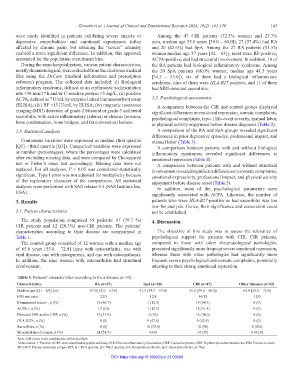
        were  easily  identified  in  patients  exhibiting  severe  anxiety  or   Among  the  47  CIR  patients  (72.3%  women  and  27.7%
        depressive  comorbidities  and  emotional  experiences  (often   men; median age 55.0 years [39.0 – 60.0]), 27 (57.4%) had RA
        affected  by  chronic  pain),  but  retaining  the  “severe”  intensity   and  20  (42.6%)  had  SpA. Among  the  27  RA  patients  (81.5%
        enabled a more significant difference. In addition, this approach   women median age 57 years [52 – 63]), most were RF-positive,
        accounted for the population recruitment bias.          ACPA-positive, and had structural involvement. In addition, 10 of
          During the same hospitalization, various patient characteristics,   the RA patients had biological inflammatory syndrome. Among
        mostly rheumatological, were collected from the electronic medical   the  20  SpA  patients  (60.0%  women;  median  age  41.5  years
        files  using  the  DxCare  (medical  information  and  prescription   [34.5  –  53.0]),  six  of  them  had  a  biological  inflammatory
        software)  program.  The  collected  data  included:  (i)  Biological   syndrome, nine of them were HLA-B27-positive, and 11 of them
        inflammatory syndrome, defined as an erythrocyte sedimentation   had MRI-detected sacroiliitis.
        rate ≥30 mm/1  h and/or C-reactive protein ≥5 mg/L; (ii) positive
                   st
        ACPA, defined as 7 U/mL by enzyme-linked immunosorbent assay   3.2. Psychological assessments
        (ELISA); (iii) RF >15 IU/mL by ELISA; (iv) magnetic resonance   A comparison between the CIR and control groups displayed
        imaging (MRI) detection of grade-2 bilateral or grade-3 unilateral   significant differences in emotional repression, somatic complaints,
        sacroiliitis, with active inflammatory (edema) or chronic (erosion,   psychological complaints, type-1 life-event severity, manual labor,
        bone condensation, bone bridges, and fat conversion) lesions.  or physical activity enjoyment before disease diagnosis (Table 2).
        2.3. Statistical analysis                                  A comparison of the RA and SpA groups revealed significant
                                                                differences in prior depressive episodes, professional impact, and
          Continuous variables were expressed as median (first quartile   manual labor (Table 3).
        [Q1] – third quartile [Q3]). Categorical variables were expressed   A comparison between  patients  with and without  biological
        as number (percentages), where the percentages were calculated   inflammatory  syndromes  revealed  significant  differences  in
        after excluding missing data, and were compared by Chi-squared   emotional repression (Table 4).
        test  or  Fisher’s  exact  test  accordingly.  Missing  data  were  not   A comparison  between  patients  with  and  without  structural
        replaced. For all analyses, P < 0.05 was considered statistically   involvement revealed significant differences in somatic complaints,
        significant. Type I error was not adjusted for multiplicity because   emotional expressivity, professional impact, and physical activity
        of  the  exploratory  character  of  the  comparisons. All  statistical   enjoyment before disease onset (Table 5).
        analyses were performed with SAS release 9.4 (SAS Institute Inc,   In  addition,  none  of  the  psychological  parameters  were
        USA).                                                   significantly  associated  with  ACPA.  Likewise,  the  number  of

        3. Results                                              patients who were HLA-B27-positive or had sacroiliitis was too
                                                                low for analysis. Hence, their significance and association could
        3.1. Patient characteristics                            not be established.
          The  study  population  comprised  59  patients:  47  (79.7  %)   4. Discussion
        CIR  patients  and  12  (20.3%)  non-CIR  patients.  The  patients’
        characteristics  according  to  their  disease  are  summarized  in   The  objective  of  this  study  was  to  assess  the  relevance  of
        Table 1.                                                psychological  support  for  patients  with  CIR.  CIR  patients,
          The control group consisted of 12 women with a median age   compared  to  those  with  other  rheumatological  pathologies,
        of  65.0  years  [55.0  –  72.0]  (nine  with  osteoarthritis,  one  with   presented significantly more frequent severe emotional repression,
        viral disease, one with osteoporosis, and one with osteomalacia).   whereas  those  with  other  pathologies  had  significantly  more
        In  addition,  the  nine  women  with  osteoarthritis  had  structural   frequent severe psychological and somatic complaints, potentially
        involvement.                                            attesting to their strong emotional repression.


        Table 1. Patients’ characteristics according to their disease (n=59)
        Characteristics                  RA (n=27)           SpA (n=20)           CIR (n=47)         Other diseases (n=12)
        Median age [Q1 – Q3] (yr)      57.0 [52.0 – 63.0]  41.5 [34.5 – 53.0]   55.0 [39.0 – 60.0]     65.0 [55.0 – 72.0]
        F/M sex ratio                      22/5                 12/8                34/13                  12/0
        Rheumatoid factor+, n (%)        18 (66.7)            1 (12.5)             19 (54.3)               0 (0)
        ACPA+, n (%)                      17 (63)             1 (12.5)             18 (51.4)               0 (0)
        Elevated ESR and/or CRP, n (%)   10 (37.0)             6 (30)              16 (34.0)               0 (0)
        HLA-B27+, n (%)                    0 (0)              9 (47.4)             9 (42.9)                0 (0)
        Sacroiliitis, n (%)                0 (0)              10 (55.6)            10 (50)                0 (0%)
        Structural involvement, n (%)    14 (51.9)             0 (0)               14 (35)                9 (81.8)
        Note: CIR refers to the combination of RA and SpA.
        Abbreviation: +: Positive; ACPA: Anti-citrullinated peptide antibody; CIR: Chronic inflammatory rheumatism; CRP: C-reactive protein; ESR: Erythrocyte sedimentation rate; F/M: Female-to-male;
        HLA-B27: Human leukocyte antigen B27; Q1: First quartile; Q3: Third quartile; RA: Rheumatoid arthritis; SpA: Spondyloarthritis; yr: Year.
                                                DOI: https://doi.org/10.36922/jctr.23.00099

