


Page 53 - JCTR-10-2
P. 53
Grondin et al. | Journal of Clinical and Translational Research 2024; 10(2): 141-150   147
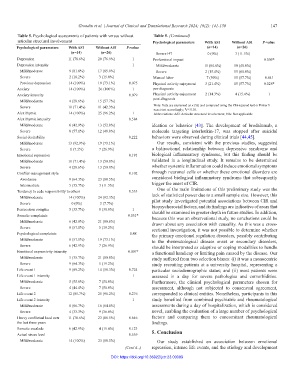
        Table 5. Psychological assessments of patients with versus without   Table 5. (Continued)
        articular structural involvement                         Psychological parameters  With ASI   Without ASI   P‑value
        Psychological parameters  With ASI   Without ASI   P‑value                     (n=14)       (n=26)
                               (n=14)      (n=26)                 Severe147             0 (0%)     3 (11.5%)
        Depression            11 (78.6%)  20 (76.9%)    1        Professional impact                           0.009*
        Depression intensity                            1         Mild/moderate       11 (84.6%)   10 (40.0%)
         Mild/moderate        9 (81.8%)   17 (85.0%)              Severe               2 (15.4%)   15 (60.0%)
         Severe               2 (18.2%)   3 (15.0%)              Manual labor          7 (50%)     15 (57.7%)   0.641
         Previous depression  14 (100%)   19 (73.1%)   0.075     Physical activity enjoyment   3 (21.4%)  15 (57.7%)  0.028*
        Anxiety               14 (100%)   26 (100%)     1        pre-diagnosis
        Anxiety intensity                              0.079     Physical activity enjoyment   2 (14.3%)  4 (15.4%)  1
         Mild/moderate        4 (28.6%)   15 (57.7%)             post-diagnosis
         Severe               10 (71.4%)  11 (42.3%)             Note: Data are expressed as n (%) and compared using the Chi-squared test or Fisher’s
                                                                 exact test accordingly; *P<0.05.
        Alexithymia           14 (100%)   25 (96.2%)    1        Abbreviations: ASI: Articular structural involvement; NA: Not applicable.
        Alexithymia intensity                          0.584
         Mild/moderate        6 (42.9%)   13 (52.0%)            ideation  or behavior  [43].  The  development  of  brodalumab,  a
         Severe               8 (57.1%)   12 (48.0%)            molecule  targeting  interleukin-17,  was  stopped  after  suicidal
        Social desirability                            0.222    behaviors were observed during clinical trials [44,45].
         Mild/moderate        13 (92.9%)  19 (73.1%)               Our  results,  consistent  with  the  previous  studies,  suggested
         Severe               1 (7.1%)    7 (26.9%)             a bidirectional  relationship  between  depressive syndrome and
        Emotional repression                           0.191    biological  inflammatory  syndrome,  but  this  finding  should  be
         Mild/moderate        10 (71.4%)  13 (50.0%)            validated  in  a  longitudinal  study.  It  remains  to  be  determined
         Severe               4 (28.6%)   13 (50.0%)            whether systemic inflammation could induce emotional symptoms
        Conflict-management style                      0.102    through neuronal cells or whether these emotional disorders are
         Avoidance            9 (64.3%)   23 (88.5%)            considered biological inflammatory syndrome that subsequently
         Intermediate         5 (35.7%)   3 (11.5%)             trigger the onset of CIR.
        Tendency to cede responsibility to others      0.533       One of the main limitations of this preliminary study was the
         Mild/moderate        14 (100%)   24 (92.3%)            lack of statistical power due to a small sample size. However, this
         Severe                0 (0%)      2 (7.7%)             pilot study investigated potential associations between CIR and
        Persecution complex   5 (35.7%)   8 (30.8%)     1       biopsychosocial factors, and its findings are indicative of areas that
                                                                should be examined in greater depth in future studies. In addition,
        Somatic complaints                            0.031*    because this was an observational study, no conclusions could be
         Mild/moderate        6 (42.9%)   21 (80.8%)            drawn about any association with causality. As this was a cross-
         Severe               8 (57.1%)   5 (19.2%)             sectional investigation, it was not possible to determine whether
        Psychological complaints                       0.48     the primary emotional regulation disorders, possibly contributing
         Mild/moderate        8 (57.1%)   19 (73.1%)            to  the  rheumatological  disease  onset  or  secondary  disorders,
         Severe               6 (42.9%)   7 (26.9%)             should be interpreted as adaptive or coping modalities to handle
        Emotional expressivity intensity              0.007*    a functional handicap or limiting pain caused by the disease. Our
         Mild/moderate        5 (35.7%)   21 (80.8%)            study suffered from two selection biases: (i) it was a monocentric
         Severe               9 (64.3%)   5 (19.2%)             study recruiting patients at a university hospital, representing a
        Life event 1          9 (69.2%)   14 (58.3%)   0.724    particular  sociodemographic  status;  and  (ii)  most  patients  were
        Life event 1 intensity                          1       assessed  in  a  day  for  severe  pathologies  and  comorbidities.
         Mild/moderate        5 (55.6%)   7 (50.0%)             Furthermore,  the  clinical  psychological  parameters  chosen  for
         Severe               4 (44.4%)   7 (50.0%)             assessment,  although  not  subjected  to  consensual  agreement,
        Life event 2          12 (85.7%)  25 (96.2%)   0.276    corresponded to clinical entities. Nonetheless, participants in this
        Life event 2 intensity                          1       study benefited from combined psychiatric and rheumatological
         Mild/moderate        8 (66.7%)   16 (64.0%)            assessments during a day of hospitalization, which is considered
         Severe               4 (33.3%)   9 (36.0%)             novel, enabling the evaluation of a large number of psychological
        Heavy conflictual load over   11 (78.6%)  23 (88.5%)  0.646  factors and comparing them to concomitant  rheumatological
        the last three years                                    findings.
        Somatic escalade      6 (42.9%)   4 (15.4%)    0.123
        Actual stress level                            0.539    5. Conclusion
         Mild/moderate        14 (100%)   23 (88.5%)               Our study established  an association  between emotional
                                                     (Cont’d...)  repression, intense life events, and the etiology and development
                                                DOI: https://doi.org/10.36922/jctr.23.00099

