


Page 10 - JCTR-10-3
P. 10
184                       Xie et al. | Journal of Clinical and Translational Research 2024; 10(3): 180-190
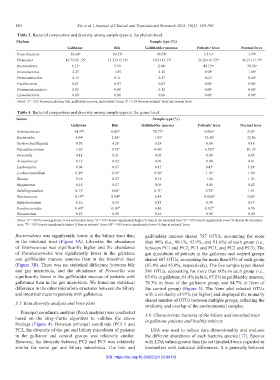
        Table 3. Bacterial composition and diversity among sample types at the phylum level.
        Phylum                                                   Sample type (%)
                              Gallstone           Bile         Gallbladder mucosa    Patients’ feces    Normal feces
        Proteobacteria         83.68 y           89.53 y            90.78 y             6.51x y            3.74 x
        Firmicutes           16.75±21.55 y     13.33±15.56 y      9.85±13.37 y       36.20±16.52 xy     44.21±11.79 x
        Bacteroidetes           6.11 y           3.76 y             2.04 y             44.13 xy           50.56 x
        Actinobacteria          2.27              1.85              2.12                0.98 x             1.10 x
        Verrucomicrobia         0.15              0.11              0.17                0.01 x             0.00 x
        Fusobacteria            0.01              0.03              0.02                0.00 x             0.00 x
        Gemmatimonadetes        0.05              0.00              0.12                0.00 x             0.00 x
        Cyanobacteria           0.00              0.00              0.00                0.00 x             0.00 x
        Notes:  P > 0.05 between gallstone, bile, gallbladder mucosa, and patients’ feces;  P < 0.05 between patients’ feces and normal feces
            x
                                                      y
        Table 4. Bacterial composition and diversity among sample types at the genus level.
        Genus                                                     Sample type (%)
                               Gallstone         Bile        Gallbladder mucosa      Patients’ feces   Normal feces
        Achromobacter            34.97 m        0.00 m            78.77 m               0.00z m           0.29 z
        Bacteroides              4.84 n          2.58 n            1.43 n               32.40 n           32.86
        Escherichia/Shigella     0.76            0.28              0.24                  0.86              0.18
        Faecalibacterium         1.26 n          0.72 n            0.46 n               6.52z n           10.15 z
        Prevotella               0.11            0.21              0.08                  0.84              0.45
        Acinetobacter            0.12            0.12              0.09                  0.00              0.01
        Lachnospira              0.08            0.17              0.15                  0.43 z           3.24 z
        Lachnoclostridium        0.20 n          0.16 n            0.08 n               1.10 n             1.80
        Blautia                  0.16            0.27              0.14                  1.62              1.03
        Megamonas                0.14            0.07              0.09                  0.05              0.02
        Subdoligranulum          0.13 n          0.08 n            0.11 n               0.74 n             1.61
        Enterococcus             0.19 M         0.04 M             0.14                 0.02z M           0.00 z
        Bifidobacterium          0.16            0.28              0.13                  0.30              0.57
        Parabacteroides          0.40 N         0.10 N             0.10                 0.82 N             0.76
        Eubacterium              0.25            0.48              0.24                  0.80              0.40
        Notes:  P < 0.05 between patients’ feces and normal feces;  P < 0.05 denote significantly higher % than in the intestinal tract;  P < 0.05 denote significantly lower % than in the intestinal
            z
                                          m
                                                                               n
        tract;  P < 0.05 denote significantly higher % than in patients’ feces; NP < 0.05 denote significantly lower % than in patients’ feces
            M
        Bacteroidetes was significantly lower in the biliary tract than   gallbladder  mucosa  shared  757  OTUs,  accounting  for  more
        in the intestinal  tract  (Figure 3A). Likewise, the abundance   than 90% (i.e., 90.1%, 93.9%, and 91.6%) of each group (i.e.,
        of  Enterococcus  was  significantly  higher  and  the  abundance   between PC1 and PC2; PC1 and PC3; and PC2 and PC3). The
        of  Parabacteroides  was  significantly  lower  in  the  gallstone   gut microbiota of patients in the gallstone and control groups
        and gallbladder mucosa  samples than  in the  intestinal  tract   shared 607 OTUs, accounting for more than 85% of each group
        (Figure 3B). There  was  no  statistical  difference  between  bile   (87.8% and 95.0%, respectively). The five sample types shared
        and gut microbiota,  and the abundance of  Prevotella was   541 OTUs, accounting for more than 60% in each group (i.e.,
        significantly lower in the gallbladder mucosa of patients with   65.6% in gallstone, 64.4% in bile, 67.1% in gallbladder mucosa,
        gallstones than in the gut microbiota. We found no statistical   78.3% in feces of the gallstone group, and 84.7% in feces of
        difference in the other microflora structures between the biliary   the  control  group) (Figure  5).  The  Venn plot  selected  OTUs
        and intestinal tracts in patients with gallstones.     with a similarity of 97% (or higher) and displayed the mutually
                                                               shared number of OTUs between multiple groups, reflecting the
        3.5. Beta diversity analysis and Venn plots
                                                               similarity and overlap of the environmental samples.
          Principal coordinate analysis (PcoA analysis) was conducted   3.6. Characteristic bacteria of the biliary and intestinal tract
        based on the Bray-Curtis algorithm  to validate  the above   in gallstone patients and healthy subjects
        findings (Figure 4). Between principal coordinate (PC) 1 and
        PC2, the diversity of the gut and biliary microbiota of patients   LDA was used to reduce data dimensionality and evaluate
        in  the  gallstone  and  control  groups was relatively  similar.   the different abundance of each bacteria species [17]. Species
        However, the diversity  between PC2 and PC3 was relatively   with LDA values greater than the set threshold were regarded as
        similar  for some gut and biliary microbiota.  The bile and   biomarkers with statistical differences. It is generally believed

                                               DOI: https://doi.org/10.36922/jctr.23.00118

