


Page 12 - JCTR-10-3
P. 12
186                       Xie et al. | Journal of Clinical and Translational Research 2024; 10(3): 180-190


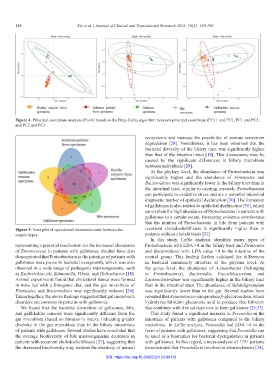
        Figure 4. Principal coordinate analysis (PcoA) based on the Bray-Curtis algorithm between principal coordinate (PC) 1 and PC2, PC1 and PC3,
        and PC2 and PC3.


                                                               ecosystems and increase  the possibility of serious ecosystem
                                                               degradation  [28]. Nonetheless, it has been observed that the
                                                               bacterial diversity of the biliary tract was significantly higher
                                                               than that of the intestinal tract [18]. This discrepancy may be
                                                               caused  by  the  significant  differences  in  biliary  microbiota
                                                               between individuals [29].
                                                                 At the phylum level, the abundance of Proteobacteria was
                                                               significantly  higher  and  the  abundance  of  Firmicutes  and
                                                               Bacteroidetes was significantly lower in the biliary tract than in
                                                               the intestinal tract, similar to existing research. Proteobacteria
                                                               can participate in oxidative stress and are a potential microbial
                                                               diagnostic marker of epithelial dysfunction [30]. The formation
                                                               of gallstones is also related to epithelial dysfunction [31], which
                                                               can explain the high abundance of Proteobacteria in patients with
                                                               gallstones to a certain extent. Increasing evidence corroborates
                                                               that  the number of Proteobacteria  in bile  from patients  with
        Figure 5. Venn plot of operational taxonomic units between the    recurrent  choledocholithiasis  is  significantly  higher  than  in
        sample types.                                          patients without cholelithiasis [32].
                                                                 In  this  study,  LefSe  analysis  identified  many  types  of
        representing a potential mechanism for the increased abundance   Proteobacteria with LDA >4 in the biliary tract and Firmicutes
        of Enterococcus in patients with gallstones. Studies have also   and  Bacteroidetes with  LDA value  >4 in the  intestine  of the
        demonstrated that Proteobacteria in the intestine of patients with   control  group.  This  finding  further  validated  the  differences
        gallstones were prone to bacterial overgrowth, which was also   in bacterial  community  structure at the phylum level.  At
        observed in a wide range of pathogenic microorganisms, such   the genus level,  the abundance  of  Acinetobacter (belonging
        as Escherichia coli, Salmonella, Vibrio, and Helicobacter [18].   to Proteobacteria),  Bacteroides,  Faecalibacterium, and
        Animal experiments found that cholesterol stones were formed   Lachnoclostridium was significantly higher in the biliary tract
        in mice fed with a lithogenic diet, and the gut microbiota of   than in the intestinal tract. The abundance of Subdoligranulum
        Firmicutes and  Bacteroidetes  was  significantly  reduced  [26].   was  significantly  lower  than  in  the  gut.  Several  studies  have
        Taken together, the above findings suggested that gut microbiota   revealed that Acinetobacter can produce β-glucuronidase, which
        disorders are common in patients with gallstones.      hydrolyzes bilirubin glucuronic acid to produce free bilirubin
          We  found  that  the  bacterial  diversities  of  gallstones,  bile,   that combines with free calcium ions to form gallstones [25,33].
        and  gallbladder  mucosa  were  significantly  different  from  the   This study found a significant increase in Prevotella in the
        gut microbiota (based on Simpson’s index), indicating greater   intestines of patients with gallstones compared to the biliary
        diversity in the gut microbiota than in the biliary microbiota   microbiota. In LefSe analysis, Prevotella had LDA >4 in the
        of patients with gallstones. Several studies have concluded that   feces of patients with gallstones, suggesting that Prevotella can
        the average biodiversity of bile microorganisms decreases in   be used as a biomarker for bacterial dysregulation in patients
        patients with recurrent choledocholithiasis [27], suggesting that   with gallstones. In this regard, a meta-analysis of 1791 patients
        the decreased biodiversity may weaken the elasticity of natural   demonstrated that Prevotella is involved in atherosclerosis [34],

                                               DOI: https://doi.org/10.36922/jctr.23.00118

